Fundamental Theorem for Line Integrals β€” Question 1

PDF β†—

Question 1

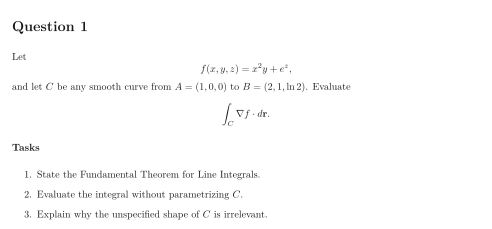
Let f(x,y,z)=x2y+ez,f(x,y,z)=x^2y+e^z, and let CC be any smooth curve from A=(1,0,0)A=(1,0,0) to B=(2,1,ln⁡2)B=(2,1,\ln 2). Evaluate ∫Cβˆ‡fβ‹…d𝒓.\int_C \nabla f\cdot d\mathbf r.

Tasks

  1. State the Fundamental Theorem for Line Integrals.

  2. Evaluate the integral without parametrizing CC.

  3. Explain why the unspecified shape of CC is irrelevant.

Original worksheet page 1: question and worked solution for 5-5-001
Show solutionHide solution

Question 1 – Solution

Strategy. Since the field is explicitly βˆ‡f\nabla f, apply the endpoint formula ∫Cβˆ‡fβ‹…d𝒓=f(B)βˆ’f(A)\int_C\nabla f\cdot d\mathbf r=f(B)-f(A).

Step 1: Evaluate the endpoint values f(B)=22(1)+eln⁡2=4+2=6,f(A)=12(0)+e0=1.f(B)=2^2(1)+e^{\ln 2}=4+2=6, \qquad f(A)=1^2(0)+e^0=1.

See the diagram in the original worksheet below.

Step 2: Apply the theorem ∫Cβˆ‡fβ‹…d𝒓=f(B)βˆ’f(A)=6βˆ’1=5.\int_C\nabla f\cdot d\mathbf r=f(B)-f(A)=6-1=\boxed{5}.

Step 3: Explain path independence Along any smooth parametrization 𝒓(t)\mathbf r(t), βˆ‡f(𝒓(t))⋅𝒓′(t)\nabla f(\mathbf r(t))\cdot\mathbf r'(t) is the derivative of f(𝒓(t))f(\mathbf r(t)). Its integral therefore records only the net change in ff.

Verification The logarithmic coordinate was chosen so that eln⁡2=2e^{\ln 2}=2; using ln⁡2\ln 2 itself in f(B)f(B) would be an endpoint-substitution error.
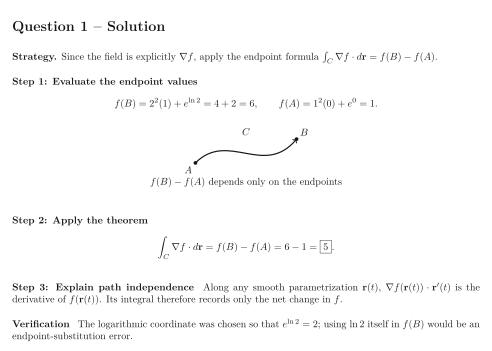
Original worksheet page 2: question and worked solution for 5-5-001

Original worksheet layout. Use Enlarge or open the PDF for a closer view.