Question 2
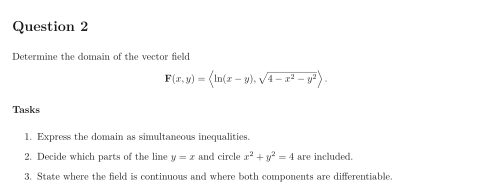
Determine the domain of the vector field
Tasks
Express the domain as simultaneous inequalities.
Decide which parts of the line and circle are included.
State where the field is continuous and where both components are differentiable.
Show solutionHide solution
Question 2 – Solution
Strategy. Intersect the natural domains of the logarithm and square root, keeping track of strict versus non-strict inequalities.
Step 1: Component restrictions The logarithm requires , while the square root requires . Therefore
See the diagram in the original worksheet below.
Step 2: Boundary decisions No point of is included because is undefined. The circular boundary is included only where ; there the second component equals and the first remains defined.
Step 3: Regularity Both component functions are continuous wherever they are defined, so is continuous on all of . Both are differentiable where their defining inequalities are strict: At the included circular arc, the square-root component is continuous but its derivatives become singular.
Verification The shaded half-disk excludes its straight diagonal edge but includes the appropriate circular arc, reflecting versus .
