Vector Fields — Question 3

PDF ↗

Question 3

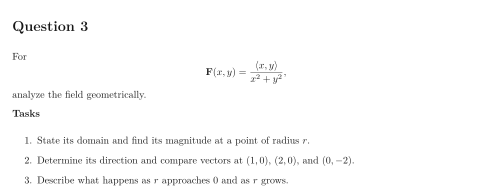
For 𝑭(x,y)=⟨x,y⟩x2+y2,\mathbf F(x,y)=\frac{\langle x,y\rangle}{x^2+y^2}, analyze the field geometrically.

Tasks

  1. State its domain and find its magnitude at a point of radius rr.

  2. Determine its direction and compare vectors at (1,0)(1,0), (2,0)(2,0), and (0,−2)(0,-2).

  3. Describe what happens as rr approaches 00 and as rr grows.

Original worksheet page 1: question and worked solution for 5-1-003
Show solutionHide solution

Question 3 – Solution

Strategy. Factor the position vector into its length and radial unit vector.

Step 1: Polar form With r=x2+y2r=\sqrt{x^2+y^2} and 𝒆r=⟨x/r,y/r⟩\mathbf e_r=\langle x/r,y/r\rangle, 𝑭=r𝒆rr2=1r𝒆r.\mathbf F=\frac{r\mathbf e_r}{r^2}=\frac 1r\mathbf e_r. Hence the domain is ℝ2\{(0,0)}\boxed{\mathbb R^2\setminus\{(0,0)\}}, the direction is radially outward, and |𝑭|=1r.\boxed{|\mathbf F|=\frac 1r}.

See the diagram in the original worksheet below.

Step 2: Samples 𝑭(1,0)=⟨1,0⟩,𝑭(2,0)=⟨12,0⟩,𝑭(0,−2)=⟨0,−12⟩.\mathbf F(1,0)=\langle 1,0\rangle,\qquad \mathbf F(2,0)=\left\langle\frac 12,0\right\rangle,\qquad \mathbf F(0,-2)=\left\langle 0,-\frac 12\right\rangle. Doubling the radius halves the arrow length while preserving radial direction.

Step 3: Limiting behavior As r→0+r\to 0^+, |𝑭|=1/r→∞|\mathbf F|=1/r\to\infty, explaining the missing origin. As r→∞r\to\infty, the magnitude tends to 00.

Verification Multiplying any vector by its radius gives 𝒆r\mathbf e_r, a unit vector, so both the direction and inverse-radius magnitude are confirmed.

Original worksheet page 2: question and worked solution for 5-1-003

Original worksheet layout. Use Enlarge or open the PDF for a closer view.