Vector Fields β€” Question 1

PDF β†—

Question 1

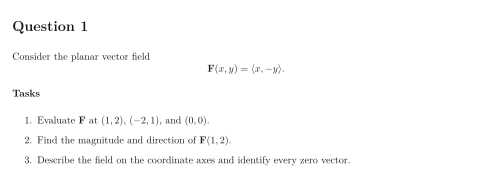
Consider the planar vector field 𝑭(x,y)=⟨x,βˆ’y⟩.\mathbf F(x,y)=\langle x,-y\rangle.

Tasks

  1. Evaluate 𝑭\mathbf F at (1,2)(1,2), (βˆ’2,1)(-2,1), and (0,0)(0,0).

  2. Find the magnitude and direction of 𝑭(1,2)\mathbf F(1,2).

  3. Describe the field on the coordinate axes and identify every zero vector.
Original worksheet page 1: question and worked solution for 5-1-001
Show solutionHide solution

Question 1 – Solution

Strategy. Evaluate the two components pointwise, then use the component signs to understand the field globally.

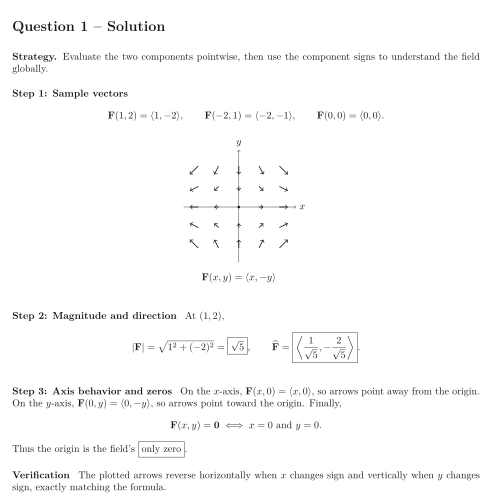
Step 1: Sample vectors 𝑭(1,2)=⟨1,βˆ’2⟩,𝑭(βˆ’2,1)=βŸ¨βˆ’2,βˆ’1⟩,𝑭(0,0)=⟨0,0⟩.\mathbf F(1,2)=\langle 1,-2\rangle,\qquad \mathbf F(-2,1)=\langle-2,-1\rangle,\qquad \mathbf F(0,0)=\langle 0,0\rangle.

See the diagram in the original worksheet below.

Step 2: Magnitude and direction At (1,2)(1,2), |𝑭|=12+(βˆ’2)2=5,𝑭̂=⟨15,βˆ’25⟩.|\mathbf F|=\sqrt{1^2+(-2)^2}=\boxed{\sqrt 5}, \qquad \widehat{\mathbf F}=\boxed{\left\langle\frac 1{\sqrt 5},-\frac 2{\sqrt 5}\right\rangle}.

Step 3: Axis behavior and zeros On the xx-axis, 𝑭(x,0)=⟨x,0⟩\mathbf F(x,0)=\langle x,0\rangle, so arrows point away from the origin. On the yy-axis, 𝑭(0,y)=⟨0,βˆ’y⟩\mathbf F(0,y)=\langle 0,-y\rangle, so arrows point toward the origin. Finally, 𝑭(x,y)=πŸŽβ‡”x=0andy=0.\mathbf F(x,y)=\mathbf 0\iff x=0\ \text{and}\ y=0. Thus the origin is the field’s .

Verification The plotted arrows reverse horizontally when xx changes sign and vertically when yy changes sign, exactly matching the formula.
Original worksheet page 2: question and worked solution for 5-1-001

Original worksheet layout. Use Enlarge or open the PDF for a closer view.