Lagrange Multipliers — Question 8

PDF ↗

Question 8

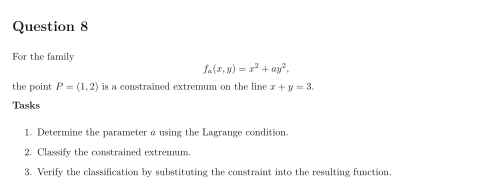
For the family fa(x,y)=x2+ay2,f_a(x,y)=x^2+ay^2, the point P=(1,2)P=(1,2) is a constrained extremum on the line x+y=3x+y=3.

Tasks

  1. Determine the parameter aa using the Lagrange condition.

  2. Classify the constrained extremum.

  3. Verify the classification by substituting the constraint into the resulting function.
Original worksheet page 1: question and worked solution for 3-5-008
Show solutionHide solution

Question 8 – Solution

Strategy. Parallel gradients at the specified regular point determine the parameter; a one-variable restriction then establishes the classification.

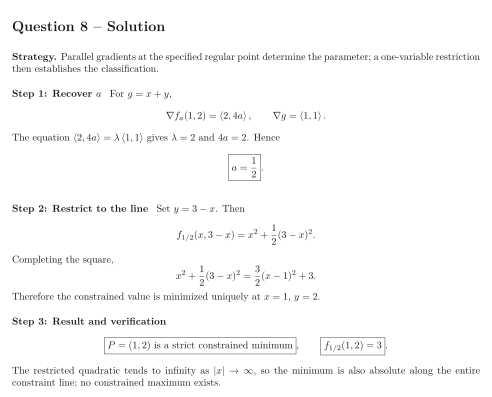
Step 1: Recover aa For g=x+yg=x+y, ∇fa(1,2)=⟨2,4a⟩,∇g=⟨1,1⟩.\nabla f_a(1,2)=\left\langle 2,4a\right\rangle, \qquad \nabla g=\left\langle 1,1\right\rangle. The equation ⟨2,4a⟩=λ⟨1,1⟩\left\langle 2,4a\right\rangle=\lambda\left\langle 1,1\right\rangle gives λ=2\lambda=2 and 4a=24a=2. Hence a=12.\boxed{a=\frac 12}.

Step 2: Restrict to the line Set y=3−xy=3-x. Then f1/2(x,3−x)=x2+12(3−x)2.f_{1/2}(x,3-x)=x^2+\frac 12(3-x)^2. Completing the square, x2+12(3−x)2=32(x−1)2+3.x^2+\frac 12(3-x)^2 =\frac 32(x-1)^2+3. Therefore the constrained value is minimized uniquely at x=1x=1, y=2y=2.

Step 3: Result and verification P=(1,2) is a strict constrained minimum,f1/2(1,2)=3.\boxed{P=(1,2)\text{ is a strict constrained minimum}}, \qquad \boxed{f_{1/2}(1,2)=3}. The restricted quadratic tends to infinity as |x|→∞|x|\to\infty, so the minimum is also absolute along the entire constraint line; no constrained maximum exists.
Original worksheet page 2: question and worked solution for 3-5-008

Original worksheet layout. Use Enlarge or open the PDF for a closer view.