Question 7
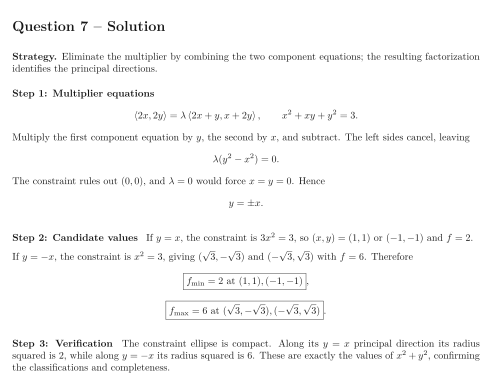
Find the constrained extrema of subject to
Tasks
Solve the Lagrange equations without assuming or is nonzero.
Determine all maximizing and minimizing points and values.
Verify the result by rewriting the constraint in rotated directions and .
Show solutionHide solution
Question 7 – Solution
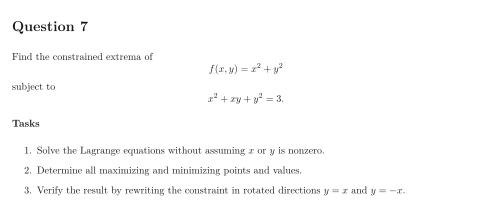
Strategy. Eliminate the multiplier by combining the two component equations; the resulting factorization identifies the principal directions.
Step 1: Multiplier equations Multiply the first component equation by , the second by , and subtract. The left sides cancel, leaving The constraint rules out , and would force . Hence
Step 2: Candidate values If , the constraint is , so or and .
If , the constraint is , giving and with . Therefore
Step 3: Verification The constraint ellipse is compact. Along its principal direction its radius squared is , while along its radius squared is . These are exactly the values of , confirming the classifications and completeness.