Question 9
A firm must choose positive inputs satisfying Its cost is
Tasks
Use Lagrange multipliers to find the cost-minimizing inputs.
Compute the minimum cost and interpret the multiplier balance.
Verify global minimality by substitution or an inequality.
Show solutionHide solution
Question 9 – Solution
Strategy. The multiplier equations balance marginal costs against the constraint normal; then a one-variable check rules out other behavior.
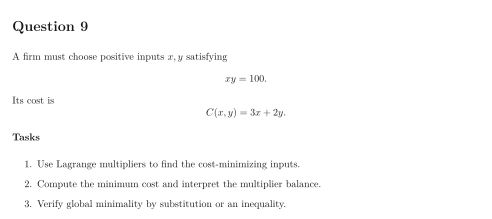
Step 1: Multiplier equations With , Thus and . Eliminating gives The positive constraint then yields so
See the diagram in the original worksheet below.
Step 2: Cost and interpretation The relation says the cost-gradient components are proportional to the production-constraint gradient components.
Step 3: Global verification Using for , as or . Its only critical point is the one found above, and . Hence it is the unique absolute constrained minimum.