Question 6
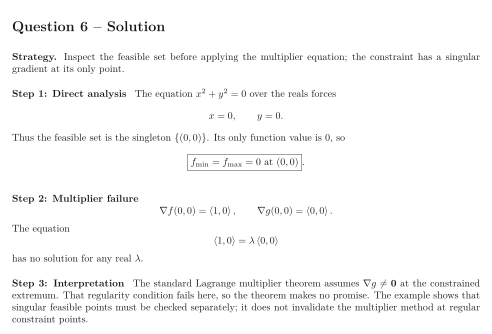
Consider maximizing and minimizing subject to the constraint
Tasks
Determine the feasible set and its constrained extrema directly.
Show that no multiplier satisfies at the feasible point.
Explain which constraint-qualification hypothesis fails and why this does not contradict the method.
Show solutionHide solution
Question 6 – Solution
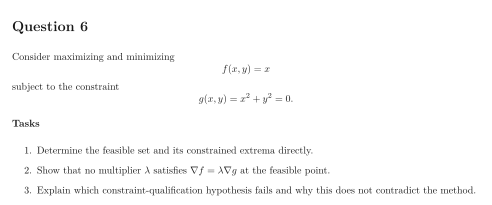
Strategy. Inspect the feasible set before applying the multiplier equation; the constraint has a singular gradient at its only point.
Step 1: Direct analysis The equation over the reals forces Thus the feasible set is the singleton . Its only function value is , so
Step 2: Multiplier failure The equation has no solution for any real .
Step 3: Interpretation The standard Lagrange multiplier theorem assumes at the constrained extremum. That regularity condition fails here, so the theorem makes no promise. The example shows that singular feasible points must be checked separately; it does not invalidate the multiplier method at regular constraint points.