Arc Length with Vector Functions — Question 3

PDF ↗

Question 3

Determine the exact length of 𝒓(t)=⟨t−t33,t2,t+t33⟩,0≤t≤2.\mathbf r(t)=\left\langle t-\frac{t^3}{3},\ t^2,\ t+\frac{t^3}{3}\right\rangle, \qquad 0\le t\le 2. Tasks

  1. Compute the speed without prematurely expanding every square.

  2. Identify and justify the perfect-square simplification.

  3. Evaluate the length and verify the speed is never negative.
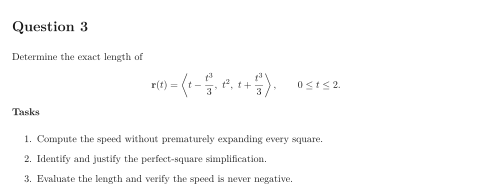
Original worksheet page 1: question and worked solution for 1-9-003
Show solutionHide solution

Question 3 – Solution

Strategy. Differentiate first and group symmetric components; the radicals collapse to a polynomial.

Step 1: Differentiate 𝒓′(t)=⟨1−t2,2t,1+t2⟩.\mathbf r'(t)=\left\langle 1-t^2,2t,1+t^2\right\rangle. Thus ∥𝒓′(t)∥2=(1−t2)2+(2t)2+(1+t2)2=(1−2t2+t4)+4t2+(1+2t2+t4)=2+4t2+2t4=2(1+t2)2.\begin{align*} \|\mathbf r'(t)\|^2 &=(1-t^2)^2+(2t)^2+(1+t^2)^2\\ &=(1-2t^2+t^4)+4t^2+(1+2t^2+t^4)\\ &=2+4t^2+2t^4\\ &=2(1+t^2)^2. \end{align*}

Step 2: Take the square root ∥𝒓′(t)∥=2|1+t2|.\|\mathbf r'(t)\|=\sqrt 2\,|1+t^2|. Since 1+t2>01+t^2>0 for every real tt, this becomes ∥𝒓′(t)∥=2(1+t2).\|\mathbf r'(t)\|=\sqrt 2(1+t^2).

Step 3: Integrate L=2∫02(1+t2)dt=2[t+t33]02=1423.\begin{align*} L&=\sqrt 2\int_0^2(1+t^2)\,dt\\ &=\sqrt 2\left[t+\frac{t^3}{3}\right]_0^2\\ &=\boxed{\frac{14\sqrt 2}{3}}. \end{align*} The speed is strictly positive because 1+t2>01+t^2>0, so the curve is regular throughout the interval.
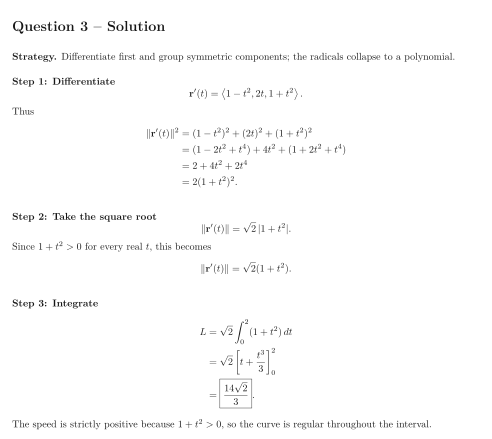
Original worksheet page 2: question and worked solution for 1-9-003

Original worksheet layout. Use Enlarge or open the PDF for a closer view.