Arc Length with Vector Functions — Question 2

PDF ↗

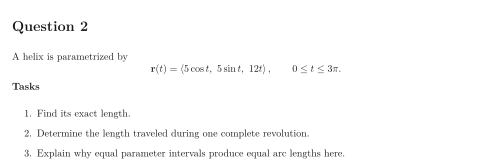
Question 2

A helix is parametrized by 𝒓(t)=⟨5cost,5sint,12t⟩,0≤t≤3π.\mathbf r(t)=\left\langle 5\cos t,\ 5\sin t,\ 12t\right\rangle,\qquad 0\le t\le 3\pi. Tasks

  1. Find its exact length.

  2. Determine the length traveled during one complete revolution.

  3. Explain why equal parameter intervals produce equal arc lengths here.
Original worksheet page 1: question and worked solution for 1-9-002
Show solutionHide solution

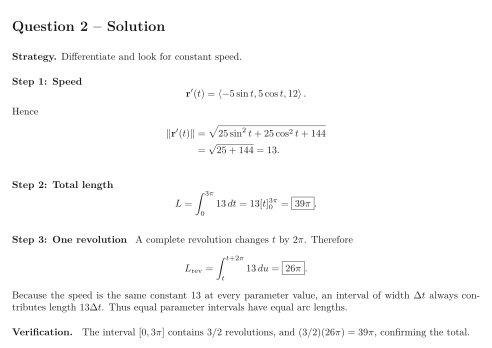
Question 2 – Solution

Strategy. Differentiate and look for constant speed.

Step 1: Speed 𝒓′(t)=⟨−5sint,5cost,12⟩.\mathbf r'(t)=\left\langle -5\sin t,5\cos t,12\right\rangle. Hence ∥𝒓′(t)∥=25sin⁡2t+25cos⁡2t+144=25+144=13.\begin{align*} \|\mathbf r'(t)\| &=\sqrt{25\sin^2t+25\cos^2t+144}\\ &=\sqrt{25+144}=13. \end{align*}

Step 2: Total length L=∫03π13dt=13[t]03π=39π.L=\int_0^{3\pi}13\,dt =13[t]_0^{3\pi} =\boxed{39\pi}.

Step 3: One revolution A complete revolution changes tt by 2π2\pi. Therefore Lrev=∫tt+2π13du=26π.L_{\mathrm{rev}}=\int_t^{t+2\pi}13\,du=\boxed{26\pi}. Because the speed is the same constant 1313 at every parameter value, an interval of width Δt\Delta t always contributes length 13Δt13\Delta t. Thus equal parameter intervals have equal arc lengths.

Verification. The interval [0,3π][0,3\pi] contains 3/23/2 revolutions, and (3/2)(26π)=39π(3/2)(26\pi)=39\pi, confirming the total.

Original worksheet page 2: question and worked solution for 1-9-002

Original worksheet layout. Use Enlarge or open the PDF for a closer view.