Arc Length with Vector Functions β€” Question 4

PDF β†—

Question 4

For 𝒓(t)=⟨3t,4t,0⟩,tβ‰₯1,\mathbf r(t)=\left\langle 3t,\ 4t,\ 0\right\rangle,\qquad t\ge 1, let s(t)s(t) denote distance traveled from the starting parameter t=1t=1.

Tasks

  1. Find s(t)s(t) and its inverse t(s)t(s).

  2. Reparametrize the curve by arc length measured from t=1t=1.

  3. Verify directly that the new parametrization has unit speed.
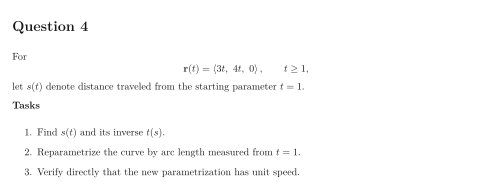
Original worksheet page 1: question and worked solution for 1-9-004
Show solutionHide solution

Question 4 – Solution

Strategy. Integrate speed from the specified base parameter, invert the resulting monotone function, and substitute.

Step 1: Arc-length function 𝒓′(t)=⟨3,4,0⟩,βˆ₯𝒓′(t)βˆ₯=5.\mathbf r'(t)=\left\langle 3,4,0\right\rangle,\qquad \|\mathbf r'(t)\|=5. Therefore s(t)=∫1t5du=5(tβˆ’1).s(t)=\int_1^t5\,du=5(t-1). Since tβ‰₯1t\ge 1, we have sβ‰₯0s\ge 0, and solving for tt gives t(s)=1+s5.\boxed{t(s)=1+\frac{s}{5}}.

Step 2: Substitute 𝑹(s)=𝒓(1+s5)=⟨3+35s,4+45s,0⟩,sβ‰₯0.\begin{align*} \mathbf R(s)&=\mathbf r\left(1+\frac{s}{5}\right)\\ &=\boxed{\left\langle 3+\tfrac 35s,\ 4+\tfrac 45s,\ 0\right\rangle},\qquad s\ge 0. \end{align*}

Step 3: Unit-speed verification 𝑹′(s)=⟨35,45,0⟩,\mathbf R'(s)=\left\langle \tfrac 35,\tfrac 45,0\right\rangle, so βˆ₯𝑹′(s)βˆ₯=925+1625=1.\|\mathbf R'(s)\|=\sqrt{\frac 9{25}+\frac{16}{25}}=1. Thus an increase of one unit in ss corresponds to exactly one unit of distance along the curve.
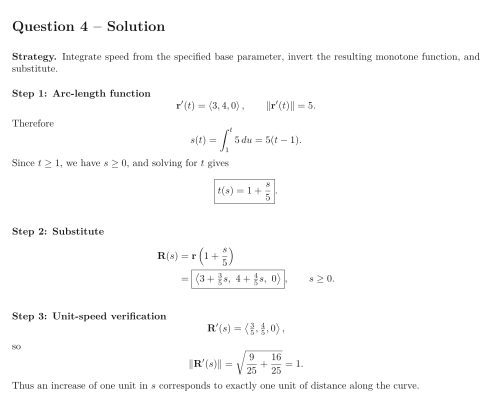
Original worksheet page 2: question and worked solution for 1-9-004

Original worksheet layout. Use Enlarge or open the PDF for a closer view.