Question 2
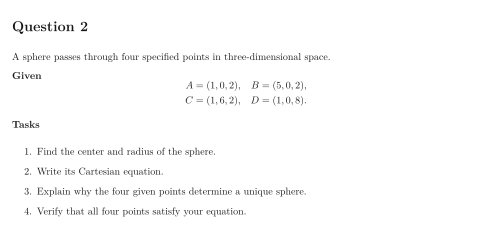
A sphere passes through four specified points in three-dimensional space.
Given
Tasks
Find the center and radius of the sphere.
Write its Cartesian equation.
Explain why the four given points determine a unique sphere.
Verify that all four points satisfy your equation.
Show solutionHide solution
Question 2 – Solution
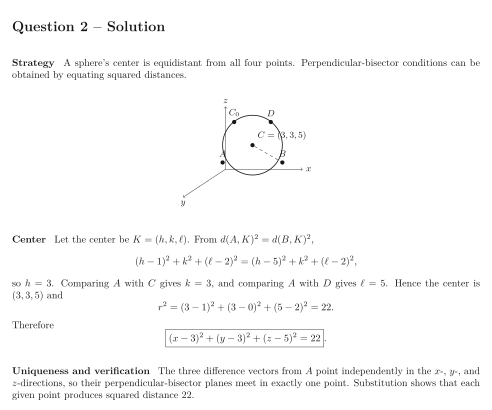
Strategy A sphere’s center is equidistant from all four points. Perpendicular-bisector conditions can be obtained by equating squared distances.
See the diagram in the original worksheet below.
Center Let the center be . From , so . Comparing with gives , and comparing with gives . Hence the center is and Therefore
Uniqueness and verification The three difference vectors from point independently in the -, -, and -directions, so their perpendicular-bisector planes meet in exactly one point. Substitution shows that each given point produces squared distance .