The 3-D Coordinate System — Question 1

PDF ↗

Question 1

A point P=(x,y,z)P=(x,y,z) is known only through its octant and its distances to the coordinate axes.

Given x<0,y>0,z<0,x<0,\qquad y>0,\qquad z<0, d(P,x-axis)=41,d(P,y-axis)=34,d(P,z-axis)=5.\begin{aligned} d(P,\text{$x$-axis})&=\sqrt{41},\\ d(P,\text{$y$-axis})&=\sqrt{34},\\ d(P,\text{$z$-axis})&=5. \end{aligned}

Tasks

  1. Determine the coordinates of PP.

  2. Verify your result using all three axis distances.

  3. Explain why only two of the three distance measurements would not determine PP uniquely.

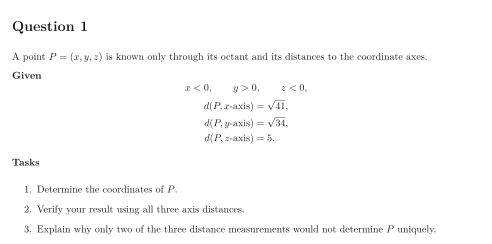
Original worksheet page 1: question and worked solution for 1-1-001
Show solutionHide solution

Question 1 – Solution

Strategy Squared distance to an axis is the sum of the squares of the other two coordinates. Solve first for x2,y2,z2x^2,y^2,z^2, then use the octant to determine signs.

See the diagram in the original worksheet below.

Equations The data give y2+z2=41,x2+z2=34,x2+y2=25.y^2+z^2=41,\qquad x^2+z^2=34,\qquad x^2+y^2=25. Adding the last two equations and subtracting the first yields 2x2=182x^2=18, so x2=9x^2=9. Similarly, 2y2=41+25−34=32,2z2=41+34−25=50.2y^2=41+25-34=32,\qquad 2z^2=41+34-25=50. Thus |x|=3|x|=3, |y|=4|y|=4, and |z|=5|z|=5. The stated octant fixes the signs: P=(−3,4,−5).\boxed{P=(-3,4,-5)}.

Verification The resulting axis distances are 42+(−5)2=41,(−3)2+(−5)2=34,(−3)2+42=5.\sqrt{4^2+(-5)^2}=\sqrt{41},\quad \sqrt{(-3)^2+(-5)^2}=\sqrt{34},\quad \sqrt{(-3)^2+4^2}=5. With only two distances, one squared coordinate would remain free, so the third is essential.
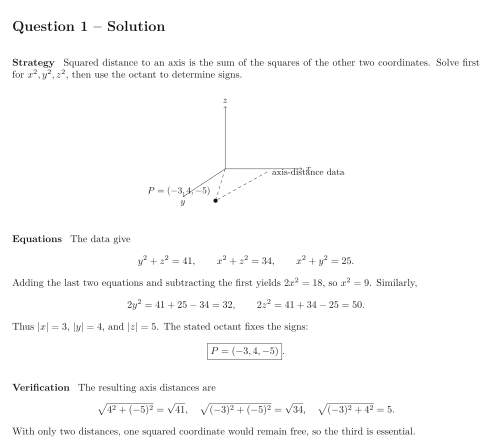
Original worksheet page 2: question and worked solution for 1-1-001

Original worksheet layout. Use Enlarge or open the PDF for a closer view.