Question 3
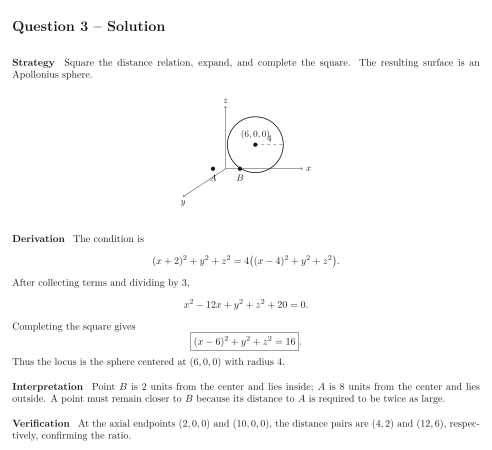
Consider the fixed points and let satisfy the distance condition
Tasks
Derive a Cartesian equation for the locus of all possible points .
Identify the surface by stating its center and radius.
Determine which of and lies inside the surface.
Explain geometrically what the factor requires of points on the locus.
Show solutionHide solution
Question 3 – Solution
Strategy Square the distance relation, expand, and complete the square. The resulting surface is an Apollonius sphere.
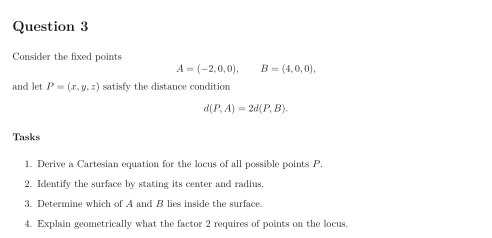
See the diagram in the original worksheet below.
Derivation The condition is After collecting terms and dividing by , Completing the square gives Thus the locus is the sphere centered at with radius .
Interpretation Point is units from the center and lies inside; is units from the center and lies outside. A point must remain closer to because its distance to is required to be twice as large.
Verification At the axial endpoints and , the distance pairs are and , respectively, confirming the ratio.