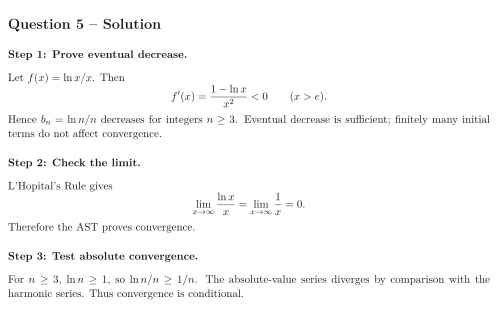
Question 5
Consider .
Use a continuous derivative to prove eventual decrease of the magnitude.
Verify the zero-limit condition and apply the AST.
Test absolute convergence and classify the series.
Show solutionHide solution
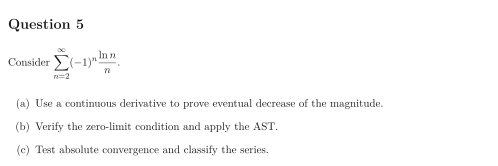
Question 5 – Solution
Step 1: Prove eventual decrease.
Let . Then Hence decreases for integers . Eventual decrease is sufficient; finitely many initial terms do not affect convergence.
Step 2: Check the limit.
L’Hopital’s Rule gives Therefore the AST proves convergence.
Step 3: Test absolute convergence.
For , , so . The absolute-value series diverges by comparison with the harmonic series. Thus convergence is conditional.