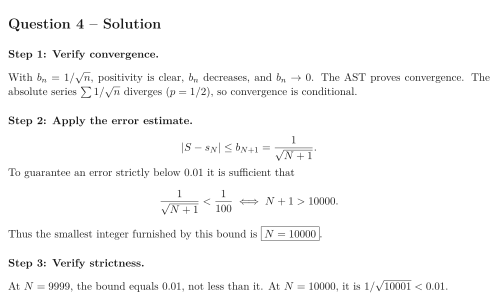
Question 4
Consider .
Verify the AST hypotheses and classify absolute versus conditional convergence.
Find the smallest for which the next-term bound is strictly below , thereby guaranteeing .
Explain the role of the strict inequality.
Show solutionHide solution
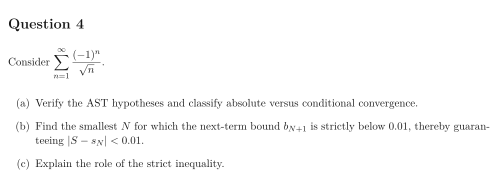
Question 4 – Solution
Step 1: Verify convergence.
With , positivity is clear, decreases, and . The AST proves convergence. The absolute series diverges (), so convergence is conditional.
Step 2: Apply the error estimate.
To guarantee an error strictly below it is sufficient that Thus the smallest integer furnished by this bound is .
Step 3: Verify strictness.
At , the bound equals , not less than it. At , it is .