Question 6
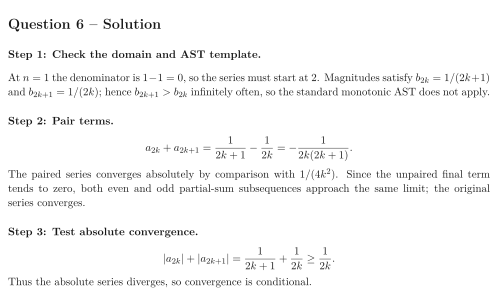
Consider .
Explain the corrected starting index and why the usual AST magnitude is not decreasing.
Pair consecutive even and odd terms to test convergence.
Test absolute convergence and classify the series.
Show solutionHide solution
Question 6 – Solution
Step 1: Check the domain and AST template.
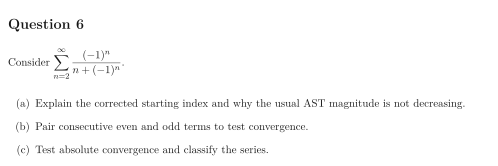
At the denominator is , so the series must start at . Magnitudes satisfy and ; hence infinitely often, so the standard monotonic AST does not apply.
Step 2: Pair terms.
The paired series converges absolutely by comparison with . Since the unpaired final term tends to zero, both even and odd partial-sum subsequences approach the same limit; the original series converges.
Step 3: Test absolute convergence.
Thus the absolute series diverges, so convergence is conditional.