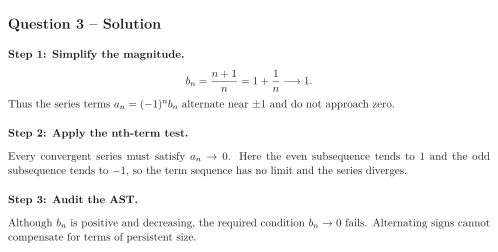
Question 3
Consider .
Evaluate the limit of the term magnitude.
Apply the nth-term test before considering the AST.
Explain exactly which AST condition fails.
Show solutionHide solution
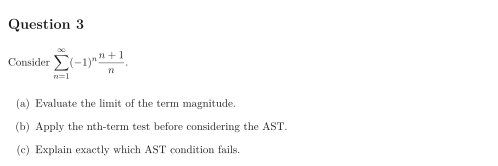
Question 3 – Solution
Step 1: Simplify the magnitude.
Thus the series terms alternate near and do not approach zero.
Step 2: Apply the nth-term test.
Every convergent series must satisfy . Here the even subsequence tends to and the odd subsequence tends to , so the term sequence has no limit and the series diverges.
Step 3: Audit the AST.
Although is positive and decreasing, the required condition fails. Alternating signs cannot compensate for terms of persistent size.