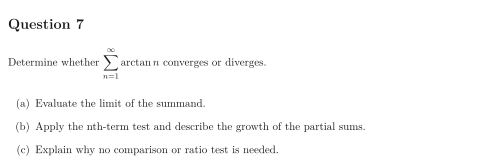
Question 7
Determine whether converges or diverges.
Evaluate the limit of the summand.
Apply the nth-term test and describe the growth of the partial sums.
Explain why no comparison or ratio test is needed.
Show solutionHide solution
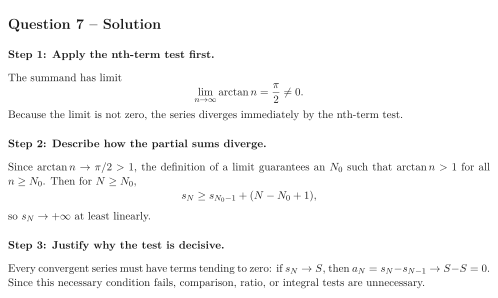
Question 7 – Solution
Step 1: Apply the nth-term test first.
The summand has limit Because the limit is not zero, the series diverges immediately by the nth-term test.
Step 2: Describe how the partial sums diverge.
Since , the definition of a limit guarantees an such that for all . Then for , so at least linearly.
Step 3: Justify why the test is decisive.
Every convergent series must have terms tending to zero: if , then . Since this necessary condition fails, comparison, ratio, or integral tests are unnecessary.