Question 8
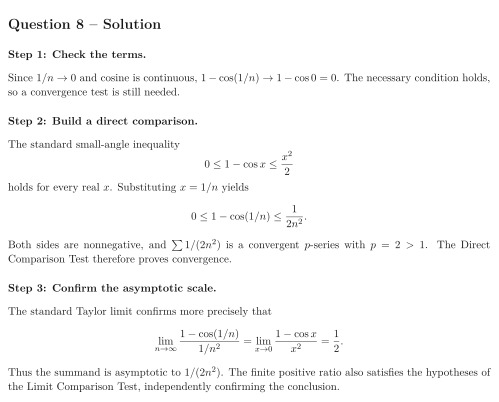
Determine whether converges or diverges.
Verify that the terms approach zero.
Use to obtain a direct comparison.
Confirm the quadratic scale by computing a limit-comparison ratio.
Show solutionHide solution
Question 8 – Solution
Step 1: Check the terms.
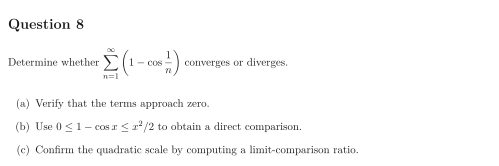
Since and cosine is continuous, . The necessary condition holds, so a convergence test is still needed.
Step 2: Build a direct comparison.
The standard small-angle inequality holds for every real . Substituting yields Both sides are nonnegative, and is a convergent -series with . The Direct Comparison Test therefore proves convergence.
Step 3: Confirm the asymptotic scale.
The standard Taylor limit confirms more precisely that Thus the summand is asymptotic to . The finite positive ratio also satisfies the hypotheses of the Limit Comparison Test, independently confirming the conclusion.