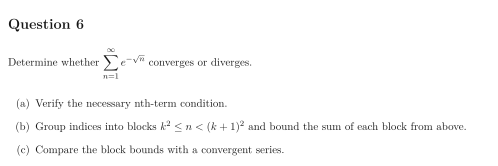
Question 6
Determine whether converges or diverges.
Verify the necessary nth-term condition.
Group indices into blocks and bound the sum of each block from above.
Compare the block bounds with a convergent series.
Show solutionHide solution
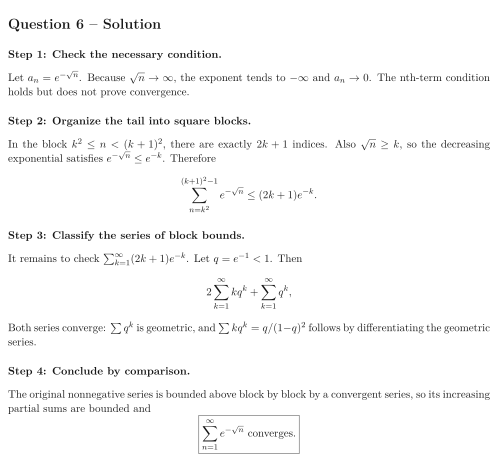
Question 6 – Solution
Step 1: Check the necessary condition.
Let . Because , the exponent tends to and . The nth-term condition holds but does not prove convergence.
Step 2: Organize the tail into square blocks.
In the block , there are exactly indices. Also , so the decreasing exponential satisfies . Therefore
Step 3: Classify the series of block bounds.
It remains to check . Let . Then Both series converge: is geometric, and follows by differentiating the geometric series.
Step 4: Conclude by comparison.
The original nonnegative series is bounded above block by block by a convergent series, so its increasing partial sums are bounded and