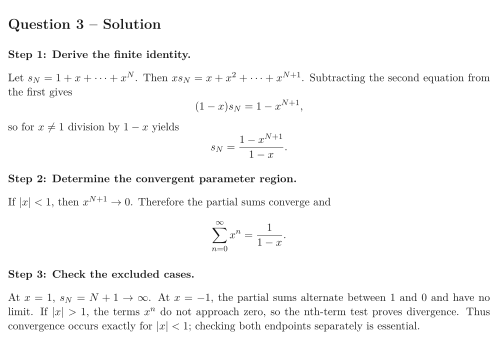
Question 3
For a real parameter , consider .
For , derive the finite identity .
Determine every for which the infinite series converges and find its sum there.
Analyze , , and separately.
Show solutionHide solution
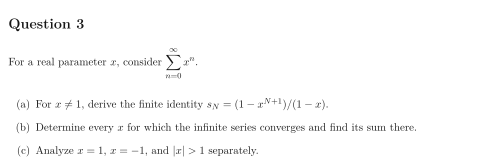
Question 3 – Solution
Step 1: Derive the finite identity.
Let . Then . Subtracting the second equation from the first gives so for division by yields
Step 2: Determine the convergent parameter region.
If , then . Therefore the partial sums converge and
Step 3: Check the excluded cases.
At , . At , the partial sums alternate between and and have no limit. If , the terms do not approach zero, so the nth-term test proves divergence. Thus convergence occurs exactly for ; checking both endpoints separately is essential.