Question 4
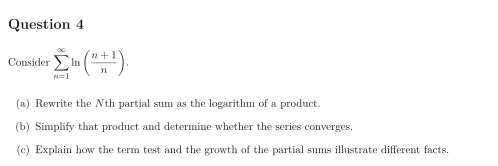
Consider .
Rewrite the th partial sum as the logarithm of a product.
Simplify that product and determine whether the series converges.
Explain how the term test and the growth of the partial sums illustrate different facts.
Show solutionHide solution
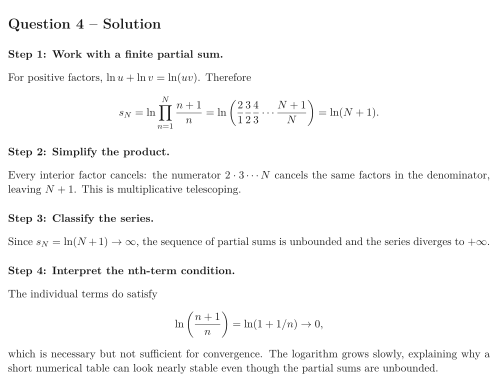
Question 4 – Solution
Step 1: Work with a finite partial sum.
For positive factors, . Therefore
Step 2: Simplify the product.
Every interior factor cancels: the numerator cancels the same factors in the denominator, leaving . This is multiplicative telescoping.
Step 3: Classify the series.
Since , the sequence of partial sums is unbounded and the series diverges to .
Step 4: Interpret the nth-term condition.
The individual terms do satisfy which is necessary but not sufficient for convergence. The logarithm grows slowly, explaining why a short numerical table can look nearly stable even though the partial sums are unbounded.