Question 2
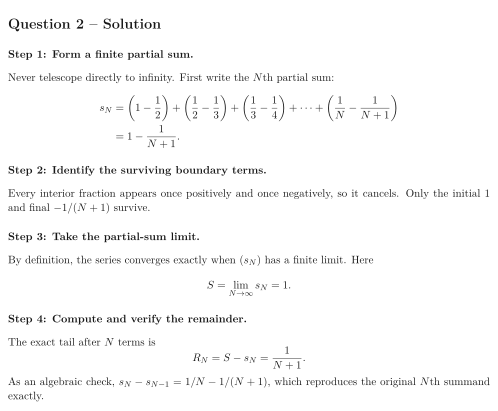
Consider .
Write out the first four terms and display the cancellation.
Find a formula for the th partial sum, identifying the surviving boundary terms.
Decide whether the series converges and, if so, find its sum and exact remainder.
Show solutionHide solution
Question 2 – Solution
Step 1: Form a finite partial sum.
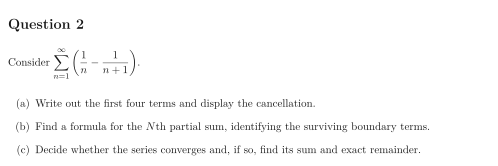
Never telescope directly to infinity. First write the th partial sum:
Step 2: Identify the surviving boundary terms.
Every interior fraction appears once positively and once negatively, so it cancels. Only the initial and final survive.
Step 3: Take the partial-sum limit.
By definition, the series converges exactly when has a finite limit. Here
Step 4: Compute and verify the remainder.
The exact tail after terms is As an algebraic check, , which reproduces the original th summand exactly.