Binomial Series — Question 3

PDF ↗

Question 3

Find the first four nonzero terms of (1+x)−1/2(1+x)^{-1/2} using generalized binomial coefficients. Explain the signs and determine the exact interval of convergence.

Original worksheet page 1: question and worked solution for 4-18-003
Show solutionHide solution

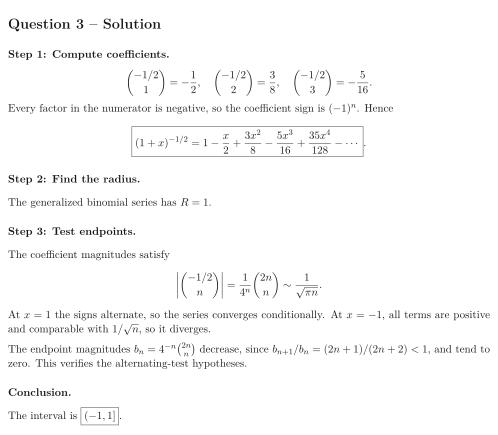
Question 3 – Solution

Step 1: Compute coefficients.

(−1/21)=−12,(−1/22)=38,(−1/23)=−516.\binom{-1/2}{1}=-\frac12,\quad \binom{-1/2}{2}=\frac38,\quad \binom{-1/2}{3}=-\frac5{16}. Every factor in the numerator is negative, so the coefficient sign is (−1)n(-1)^n. Hence (1+x)−1/2=1−x2+3x28−5x316+35x4128−⋯.\boxed{(1+x)^{-1/2}=1-\frac{x}{2}+\frac{3x^2}{8}-\frac{5x^3}{16}+\frac{35x^4}{128}-\cdots}.

Step 2: Find the radius.

The generalized binomial series has R=1R=1.

Step 3: Test endpoints.

The coefficient magnitudes satisfy |(−1/2n)|=14n(2nn)∼1πn.\left|\binom{-1/2}{n}\right|=\frac1{4^n}\binom{2n}{n}\sim\frac1{\sqrt{\pi n}}. At x=1x=1 the signs alternate, so the series converges conditionally. At x=−1x=-1, all terms are positive and comparable with 1/n1/\sqrt n, so it diverges.

The endpoint magnitudes bn=4−n(2nn)b_n=4^{-n}\binom{2n}{n} decrease, since bn+1/bn=(2n+1)/(2n+2)<1b_{n+1}/b_n=(2n+1)/(2n+2)<1, and tend to zero. This verifies the alternating-test hypotheses.

Conclusion.

The interval is (−1,1]\boxed{(-1,1]}.

Original worksheet page 2: question and worked solution for 4-18-003

Original worksheet layout. Use Enlarge or open the PDF for a closer view.