Binomial Series — Question 4

PDF ↗

Question 4

Expand (1−2x)3/2(1-2x)^{3/2} through the x4x^4 term. Track the substitution u=−2xu=-2x carefully, then find the radius and endpoint behavior.

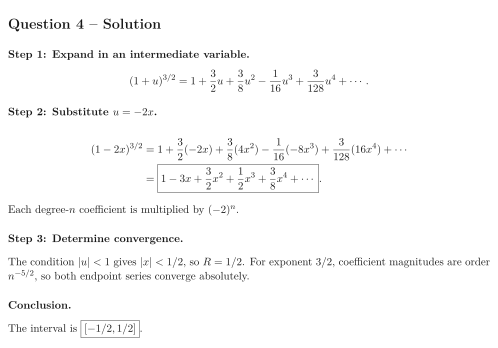
Original worksheet page 1: question and worked solution for 4-18-004
Show solutionHide solution

Question 4 – Solution

Step 1: Expand in an intermediate variable.

(1+u)3/2=1+32u+38u2−116u3+3128u4+⋯.(1+u)^{3/2}=1+\frac32u+\frac38u^2-\frac1{16}u^3+\frac3{128}u^4+\cdots.

Step 2: Substitute u=−2xu=-2x.

(1−2x)3/2=1+32(−2x)+38(4x2)−116(−8x3)+3128(16x4)+⋯=1−3x+32x2+12x3+38x4+⋯.\begin{align*} (1-2x)^{3/2}&=1+\frac32(-2x)+\frac38(4x^2)-\frac1{16}(-8x^3)+\frac3{128}(16x^4)+\cdots\\&=\boxed{1-3x+\frac32x^2+\frac12x^3+\frac38x^4+\cdots}. \end{align*} Each degree-nn coefficient is multiplied by (−2)n(-2)^n.

Step 3: Determine convergence.

The condition |u|<1|u|<1 gives |x|<1/2|x|<1/2, so R=1/2R=1/2. For exponent 3/23/2, coefficient magnitudes are order n−5/2n^{-5/2}, so both endpoint series converge absolutely.

Conclusion.

The interval is [−1/2,1/2]\boxed{[-1/2,1/2]}.

Original worksheet page 2: question and worked solution for 4-18-004

Original worksheet layout. Use Enlarge or open the PDF for a closer view.