Binomial Series — Question 2

PDF ↗

Question 2

Treat (1+x)−1(1+x)^{-1} as a generalized binomial series. Derive its coefficients, connect the result with a geometric series, and determine the exact interval of convergence.

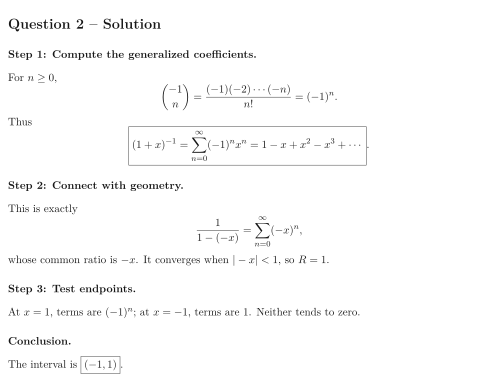
Original worksheet page 1: question and worked solution for 4-18-002
Show solutionHide solution

Question 2 – Solution

Step 1: Compute the generalized coefficients.

For n≥0n\ge0, (−1n)=(−1)(−2)⋯(−n)n!=(−1)n.\binom{-1}{n}=\frac{(-1)(-2)\cdots(-n)}{n!}=(-1)^n. Thus (1+x)−1=∑n=0∞(−1)nxn=1−x+x2−x3+⋯.\boxed{(1+x)^{-1}=\sum_{n=0}^{\infty}(-1)^n x^n=1-x+x^2-x^3+\cdots}.

Step 2: Connect with geometry.

This is exactly 11−(−x)=∑n=0∞(−x)n,\frac1{1-(-x)}=\sum_{n=0}^{\infty}(-x)^n, whose common ratio is −x-x. It converges when |−x|<1|-x|<1, so R=1R=1.

Step 3: Test endpoints.

At x=1x=1, terms are (−1)n(-1)^n; at x=−1x=-1, terms are 11. Neither tends to zero.

Conclusion.

The interval is (−1,1)\boxed{(-1,1)}.

Original worksheet page 2: question and worked solution for 4-18-002

Original worksheet layout. Use Enlarge or open the PDF for a closer view.