Applications of Series — Question 2

PDF ↗

Question 2

Approximate sin⁡(0.2)\sin(0.2) so that correct rounding through four decimal places is guaranteed. Use the lowest-degree odd Maclaurin polynomial whose error bound is below 5×10−55\times10^{-5}.

Original worksheet page 1: question and worked solution for 4-17-002
Show solutionHide solution

Question 2 – Solution

Step 1: Check the linear approximation.

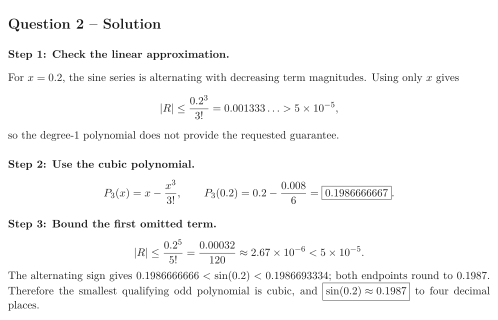
For x=0.2x=0.2, the sine series is alternating with decreasing term magnitudes. Using only xx gives |R|≤0.233!=0.001333…>5×10⁻⁵,|R|\le\frac{0.2^3}{3!}=0.001333\ldots>5\times10^{-5}, so the degree-11 polynomial does not provide the requested guarantee.

Step 2: Use the cubic polynomial.

P3(x)=x−x33!,P3(0.2)=0.2−0.0086=0.1986666667.P_3(x)=x-\frac{x^3}{3!},\qquad P_3(0.2)=0.2-\frac{0.008}{6}=\boxed{0.1986666667}.

Step 3: Bound the first omitted term.

|R|≤0.255!=0.00032120≈2.67×10⁻⁶<5×10⁻⁵.|R|\le\frac{0.2^5}{5!}=\frac{0.00032}{120}\approx2.67\times10^{-6}<5\times10^{-5}. The alternating sign gives 0.1986666666<sin⁡(0.2)<0.19866933340.1986666666<\sin(0.2)<0.1986693334; both endpoints round to 0.19870.1987. Therefore the smallest qualifying odd polynomial is cubic, and sin⁡(0.2)≈0.1987\boxed{\sin(0.2)\approx0.1987} to four decimal places.

Original worksheet page 2: question and worked solution for 4-17-002

Original worksheet layout. Use Enlarge or open the PDF for a closer view.