Applications of Series — Question 3

PDF ↗

Question 3

Evaluate lim⁡x→0ex−1−xx2\displaystyle\lim_{x\to0}\frac{e^x-1-x}{x^2} by using a Taylor expansion. Identify why the constant and linear terms disappear and which coefficient determines the limit.

Original worksheet page 1: question and worked solution for 4-17-003
Show solutionHide solution

Question 3 – Solution

Step 1: Expand far enough to survive the cancellation.

ex=1+x+x22+x36+O(x4).e^x=1+x+\frac{x^2}{2}+\frac{x^3}{6}+O(x^4).

Step 2: Subtract the specified terms.

ex−1−x=x22+x36+O(x4).e^x-1-x=\frac{x^2}{2}+\frac{x^3}{6}+O(x^4). The constant 11 and linear term xx cancel exactly.

Step 3: Divide by x2x^2.

ex−1−xx2=12+x6+O(x2).\frac{e^x-1-x}{x^2}=\frac12+\frac{x}{6}+O(x^2). As x→0x\to0, every remaining positive-power term tends to zero.

Conclusion.

limx→0ex−1−xx2=12.\boxed{\displaystyle\lim_{x\to0}\frac{e^x-1-x}{x^2}=\frac12}. The answer is the first Taylor coefficient not removed by the numerator’s subtraction.
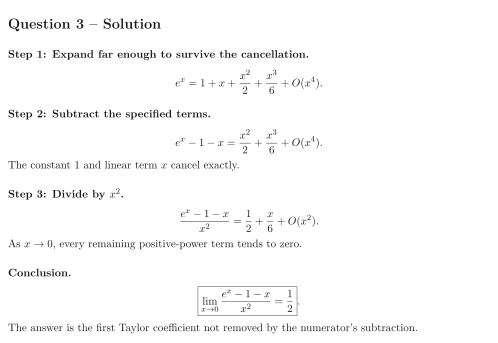
Original worksheet page 2: question and worked solution for 4-17-003

Original worksheet layout. Use Enlarge or open the PDF for a closer view.