Applications of Series — Question 1

PDF ↗

Question 1

Approximate e0.1e^{0.1} using the cubic Maclaurin polynomial for exe^x. Then use the Lagrange remainder to give a rigorous upper bound for the absolute error.

Original worksheet page 1: question and worked solution for 4-17-001
Show solutionHide solution

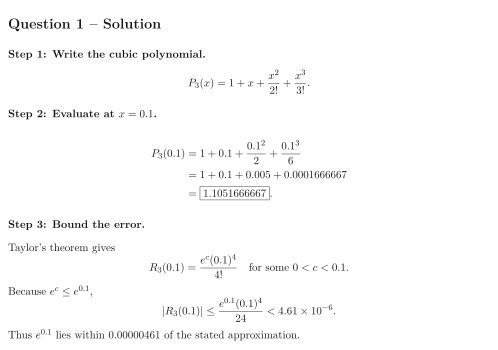
Question 1 – Solution

Step 1: Write the cubic polynomial.

P3(x)=1+x+x22!+x33!.P_3(x)=1+x+\frac{x^2}{2!}+\frac{x^3}{3!}.

Step 2: Evaluate at x=0.1x=0.1.

P3(0.1)=1+0.1+0.122+0.136=1+0.1+0.005+0.0001666667=1.1051666667.\begin{align*} P_3(0.1)&=1+0.1+\frac{0.1^2}{2}+\frac{0.1^3}{6}\\&=1+0.1+0.005+0.0001666667\\&=\boxed{1.1051666667}. \end{align*}

Step 3: Bound the error.

Taylor’s theorem gives R3(0.1)=ec(0.1)44!for some 0<c<0.1.R_3(0.1)=\frac{e^c(0.1)^4}{4!}\quad\text{for some }0<c<0.1. Because ec≤e0.1e^c\le e^{0.1}, |R3(0.1)|≤e0.1(0.1)424<4.61×10⁻⁶.|R_3(0.1)|\le\frac{e^{0.1}(0.1)^4}{24}<4.61\times10^{-6}. Thus e0.1e^{0.1} lies within 0.000004610.00000461 of the stated approximation.

Original worksheet page 2: question and worked solution for 4-17-001

Original worksheet layout. Use Enlarge or open the PDF for a closer view.