Question 3
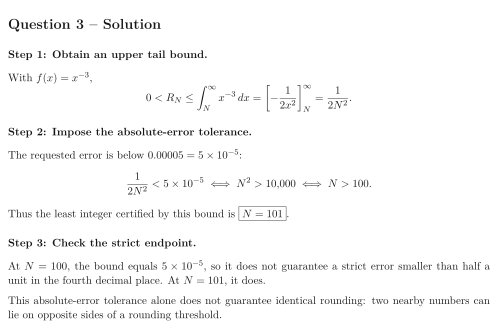
Let . Using the Integral Test upper remainder bound, find the least final index certified to give absolute error . Explain whether this tolerance alone guarantees identical rounding to four decimal places.
Show solutionHide solution
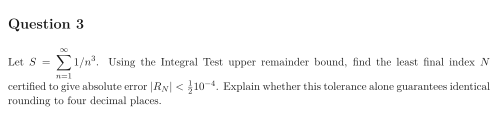
Question 3 – Solution
Step 1: Obtain an upper tail bound.
With ,
Step 2: Impose the absolute-error tolerance.
The requested error is below : Thus the least integer certified by this bound is .
Step 3: Check the strict endpoint.
At , the bound equals , so it does not guarantee a strict error smaller than half a unit in the fourth decimal place. At , it does.
This absolute-error tolerance alone does not guarantee identical rounding: two nearby numbers can lie on opposite sides of a rounding threshold.