Estimating the Value of a Series — Question 4

PDF ↗

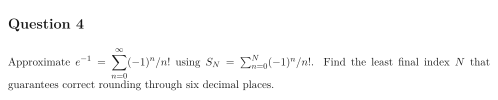
Question 4

Approximate e−1=∑n=0∞(−1)n/n!\displaystyle e^{-1}=\sum_{n=0}^{\infty}(-1)^n/n! using SN=∑n=0N(−1)n/n!S_N=\sum_{n=0}^{N}(-1)^n/n!. Find the least final index NN that guarantees correct rounding through six decimal places.
Original worksheet page 1: question and worked solution for 4-13-004
Show solutionHide solution

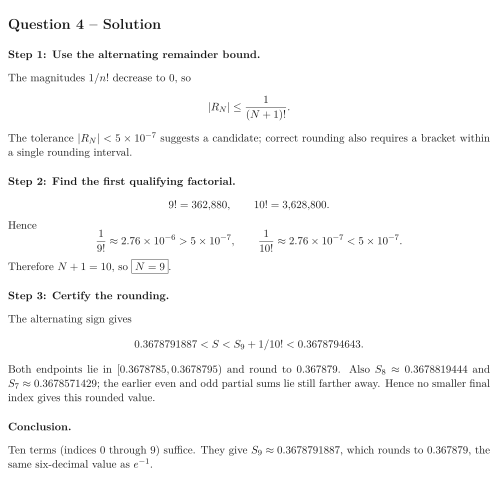
Question 4 – Solution

Step 1: Use the alternating remainder bound.

The magnitudes 1/n!1/n! decrease to 00, so |RN|≤1(N+1)!.|R_N|\le\frac1{(N+1)!}. The tolerance |RN|<5×10⁻⁷|R_N|<5\times10^{-7} suggests a candidate; correct rounding also requires a bracket within a single rounding interval.

Step 2: Find the first qualifying factorial.

9!=362,880,10!=3,628,800.9!=362{,}880,\qquad 10!=3{,}628{,}800. Hence 19!≈2.76×10⁻⁶>5×10−7,110!≈2.76×10⁻⁷<5×10⁻⁷.\frac1{9!}\approx2.76\times10^{-6}>5\times10^{-7},\qquad \frac1{10!}\approx2.76\times10^{-7}<5\times10^{-7}. Therefore N+1=10N+1=10, so N=9\boxed{N=9}.

Step 3: Certify the rounding.

The alternating sign gives 0.3678791887<S<S9+1/10!<0.3678794643.0.3678791887<S<S_9+1/10!<0.3678794643. Both endpoints lie in [0.3678785,0.3678795)[0.3678785,0.3678795) and round to 0.3678790.367879. Also S8≈0.3678819444S_8\approx0.3678819444 and S7≈0.3678571429S_7\approx0.3678571429; the earlier even and odd partial sums lie still farther away. Hence no smaller final index gives this rounded value.

Conclusion.

Ten terms (indices 00 through 99) suffice. They give S9≈0.3678791887S_9\approx0.3678791887, which rounds to 0.3678790.367879, the same six-decimal value as e−1e^{-1}.

Original worksheet page 2: question and worked solution for 4-13-004

Original worksheet layout. Use Enlarge or open the PDF for a closer view.