Estimating the Value of a Series — Question 2

PDF ↗

Question 2

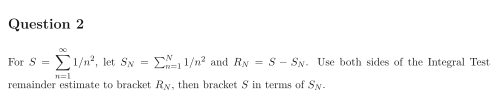
For S=∑n=1∞1/n2\displaystyle S=\sum_{n=1}^{\infty}1/n^2, let SN=∑n=1N1/n2S_N=\sum_{n=1}^{N}1/n^2 and RN=S−SNR_N=S-S_N. Use both sides of the Integral Test remainder estimate to bracket RNR_N, then bracket SS in terms of SNS_N.

Original worksheet page 1: question and worked solution for 4-13-002
Show solutionHide solution

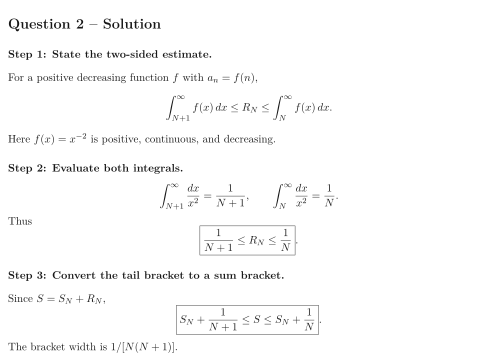
Question 2 – Solution

Step 1: State the two-sided estimate.

For a positive decreasing function ff with an=f(n)a_n=f(n), ∫N+1∞f(x)dx≤RN≤∫N∞f(x)dx.\int_{N+1}^{\infty}f(x)\,dx\le R_N\le\int_N^{\infty}f(x)\,dx. Here f(x)=x−2f(x)=x^{-2} is positive, continuous, and decreasing.

Step 2: Evaluate both integrals.

∫N+1∞dxx2=1N+1,∫N∞dxx2=1N.\int_{N+1}^{\infty}\frac{dx}{x^2}=\frac1{N+1},\qquad \int_N^{\infty}\frac{dx}{x^2}=\frac1N. Thus 1N+1≤RN≤1N.\boxed{\frac1{N+1}\le R_N\le\frac1N}.

Step 3: Convert the tail bracket to a sum bracket.

Since S=SN+RNS=S_N+R_N, SN+1N+1≤S≤SN+1N.\boxed{S_N+\frac1{N+1}\le S\le S_N+\frac1N}. The bracket width is 1/[N(N+1)]1/[N(N+1)].

Original worksheet page 2: question and worked solution for 4-13-002

Original worksheet layout. Use Enlarge or open the PDF for a closer view.