Proof of Various Derivative Properties — Question 2

PDF ↗

Question 2

Assume that ff is differentiable at x=ax=a and that cc is a constant. Prove that (cf)′(a)=cf′(a).(cf)'(a)=c\,f'(a).

Original worksheet page 1: question and worked solution for 7-2-002
Show solutionHide solution

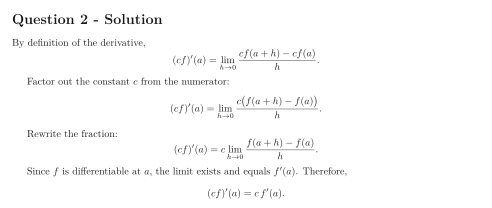
Question 2 - Solution

By definition of the derivative, (cf)′(a)=limh→0cf(a+h)−cf(a)h.(cf)'(a)=\lim_{h\to 0}\frac{cf(a+h)-cf(a)}{h}.

Factor out the constant cc from the numerator: (cf)′(a)=limh→0c(f(a+h)−f(a))h.(cf)'(a) = \lim_{h\to 0}\frac{c\bigl(f(a+h)-f(a)\bigr)}{h}.

Rewrite the fraction: (cf)′(a)=climh→0f(a+h)−f(a)h.(cf)'(a) = c\lim_{h\to 0}\frac{f(a+h)-f(a)}{h}.

Since ff is differentiable at aa, the limit exists and equals f′(a)f'(a). Therefore, (cf)′(a)=cf′(a).(cf)'(a)=c\,f'(a).

Original worksheet page 2: question and worked solution for 7-2-002

Original worksheet layout. Use Enlarge or open the PDF for a closer view.