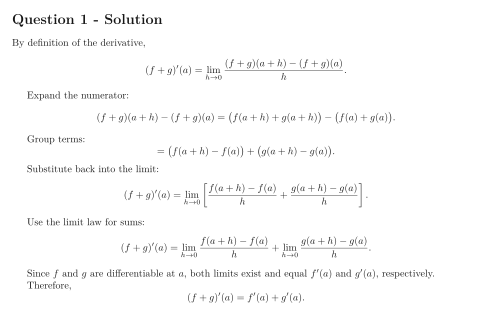
Question 1 Assume that ff and gg are differentiable at x=ax=a. Prove that (f+g)′(a)=f′(a)+g′(a).(f+g)'(a)=f'(a)+g'(a). Show solutionHide solution+Question 1 - Solution By definition of the derivative, (f+g)′(a)=limh→0(f+g)(a+h)−(f+g)(a)h.(f+g)'(a)=\lim_{h\to 0}\frac{(f+g)(a+h)-(f+g)(a)}{h}. Expand the numerator: (f+g)(a+h)−(f+g)(a)=(f(a+h)+g(a+h))−(f(a)+g(a)).(f+g)(a+h)-(f+g)(a) = \bigl(f(a+h)+g(a+h)\bigr)-\bigl(f(a)+g(a)\bigr). Group terms: =(f(a+h)−f(a))+(g(a+h)−g(a)).= \bigl(f(a+h)-f(a)\bigr)+\bigl(g(a+h)-g(a)\bigr). Substitute back into the limit: (f+g)′(a)=limh→0[f(a+h)−f(a)h+g(a+h)−g(a)h].(f+g)'(a) = \lim_{h\to 0} \left[ \frac{f(a+h)-f(a)}{h} + \frac{g(a+h)-g(a)}{h} \right]. Use the limit law for sums: (f+g)′(a)=limh→0f(a+h)−f(a)h+limh→0g(a+h)−g(a)h.(f+g)'(a) = \lim_{h\to 0}\frac{f(a+h)-f(a)}{h} + \lim_{h\to 0}\frac{g(a+h)-g(a)}{h}. Since ff and gg are differentiable at aa, both limits exist and equal f′(a)f'(a) and g′(a)g'(a), respectively. Therefore, (f+g)′(a)=f′(a)+g′(a).(f+g)'(a)=f'(a)+g'(a).