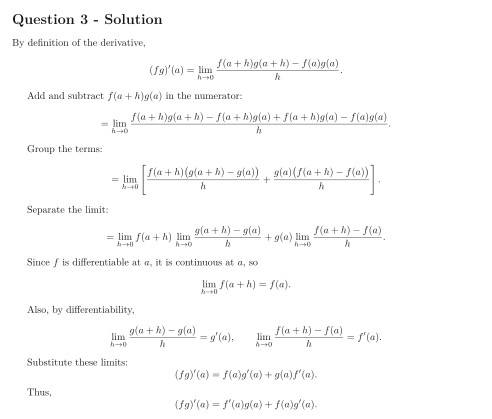
Question 3 Assume that ff and gg are differentiable at x=ax=a. Prove the product rule: (fg)′(a)=f′(a)g(a)+f(a)g′(a).(fg)'(a)=f'(a)g(a)+f(a)g'(a). Show solutionHide solution+Question 3 - Solution By definition of the derivative, (fg)′(a)=limh→0f(a+h)g(a+h)−f(a)g(a)h.(fg)'(a)=\lim_{h\to 0}\frac{f(a+h)g(a+h)-f(a)g(a)}{h}. Add and subtract f(a+h)g(a)f(a+h)g(a) in the numerator: =limh→0f(a+h)g(a+h)−f(a+h)g(a)+f(a+h)g(a)−f(a)g(a)h.= \lim_{h\to 0} \frac{f(a+h)g(a+h)-f(a+h)g(a)+f(a+h)g(a)-f(a)g(a)}{h}. Group the terms: =limh→0[f(a+h)(g(a+h)−g(a))h+g(a)(f(a+h)−f(a))h].= \lim_{h\to 0} \left[ \frac{f(a+h)\bigl(g(a+h)-g(a)\bigr)}{h} + \frac{g(a)\bigl(f(a+h)-f(a)\bigr)}{h} \right]. Separate the limit: =limh→0f(a+h)limh→0g(a+h)−g(a)h+g(a)limh→0f(a+h)−f(a)h.= \lim_{h\to 0} f(a+h)\, \lim_{h\to 0}\frac{g(a+h)-g(a)}{h} + g(a)\lim_{h\to 0}\frac{f(a+h)-f(a)}{h}. Since ff is differentiable at aa, it is continuous at aa, so limh→0f(a+h)=f(a).\lim_{h\to 0} f(a+h)=f(a). Also, by differentiability, limh→0g(a+h)−g(a)h=g′(a),limh→0f(a+h)−f(a)h=f′(a).\lim_{h\to 0}\frac{g(a+h)-g(a)}{h}=g'(a), \qquad \lim_{h\to 0}\frac{f(a+h)-f(a)}{h}=f'(a). Substitute these limits: (fg)′(a)=f(a)g′(a)+g(a)f′(a).(fg)'(a)=f(a)g'(a)+g(a)f'(a). Thus, (fg)′(a)=f′(a)g(a)+f(a)g′(a).(fg)'(a)=f'(a)g(a)+f(a)g'(a).