Question 5
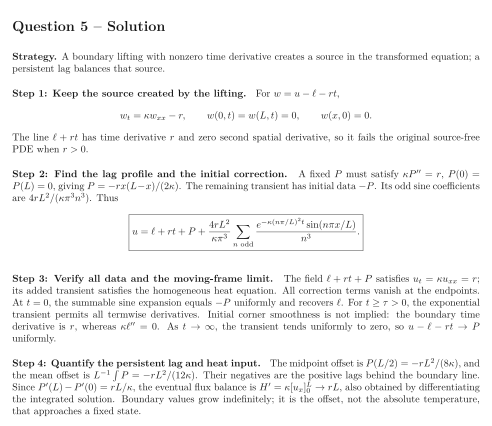
Let both endpoint temperatures rise at a constant rate : where and . You may use the sine expansion of .
Tasks
Subtract the instantaneous boundary line and derive the PDE and initial data for the remaining field. Explain why that line alone is not a solution.
Find a time-independent zero-endpoint correction so that solves the PDE. Add the transient needed to recover the original initial field.
Verify the reconstructed solution, justify the initial trace and positive-time differentiations, and determine its limiting offset relative to the moving boundary line.
Compute the limiting midpoint lag, the limiting mean lag and the eventual total-heat growth rate. Explain why there is no stationary equilibrium even though the offset approaches a fixed shape.
Show solutionHide solution
Question 5 – Solution
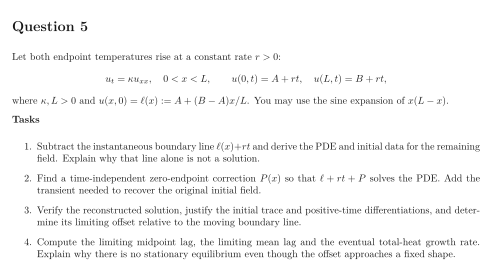
Strategy. A boundary lifting with nonzero time derivative creates a source in the transformed equation; a persistent lag balances that source.
Step 1: Keep the source created by the lifting. For , The line has time derivative and zero second spatial derivative, so it fails the original source-free PDE when .
Step 2: Find the lag profile and the initial correction. A fixed must satisfy , , giving . The remaining transient has initial data . Its odd sine coefficients are . Thus
Step 3: Verify all data and the moving-frame limit. The field satisfies ; its added transient satisfies the homogeneous heat equation. All correction terms vanish at the endpoints. At , the summable sine expansion equals uniformly and recovers . For , the exponential transient permits all termwise derivatives. Initial corner smoothness is not implied: the boundary time derivative is , whereas . As , the transient tends uniformly to zero, so uniformly.
Step 4: Quantify the persistent lag and heat input. The midpoint offset is , and the mean offset is . Their negatives are the positive lags behind the boundary line. Since , the eventual flux balance is , also obtained by differentiating the integrated solution. Boundary values grow indefinitely; it is the offset, not the absolute temperature, that approaches a fixed state.