Question 4
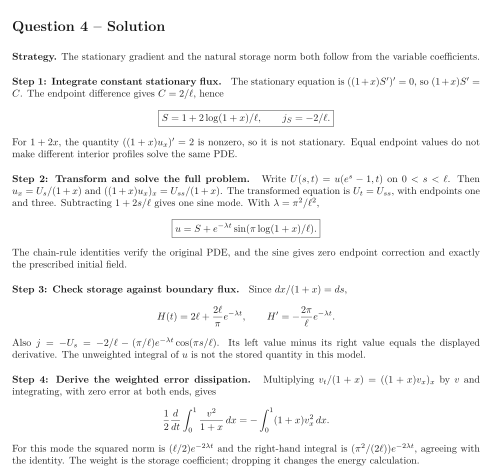
On , let the storage and conductivity vary so that Define , , and let the initial field be
Tasks
Derive the stationary temperature and stationary flux. Explain why the straight line is not stationary for this equation.
Use to transform the entire PDE and its endpoints. Construct and verify the full solution for the given initial field.
Compute the stored quantity and verify .
For the error , derive the weighted energy identity. Evaluate its weighted squared norm for this solution and explain why the weight cannot simply be omitted from the identity.
Show solutionHide solution
Question 4 – Solution
Strategy. The stationary gradient and the natural storage norm both follow from the variable coefficients.
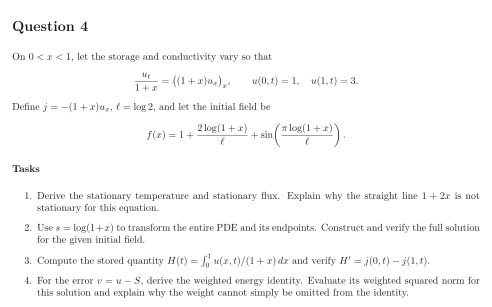
Step 1: Integrate constant stationary flux. The stationary equation is , so . The endpoint difference gives , hence For , the quantity is nonzero, so it is not stationary. Equal endpoint values do not make different interior profiles solve the same PDE.
Step 2: Transform and solve the full problem. Write on . Then and . The transformed equation is , with endpoints one and three. Subtracting gives one sine mode. With , The chain-rule identities verify the original PDE, and the sine gives zero endpoint correction and exactly the prescribed initial field.
Step 3: Check storage against boundary flux. Since , Also . Its left value minus its right value equals the displayed derivative. The unweighted integral of is not the stored quantity in this model.
Step 4: Derive the weighted error dissipation. Multiplying by and integrating, with zero error at both ends, gives For this mode the squared norm is and the right-hand integral is , agreeing with the identity. The weight is the storage coefficient; dropping it changes the energy calculation.