Question 8
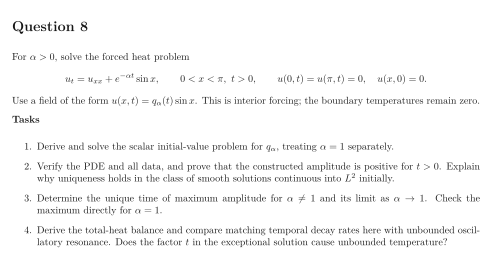
For , solve the forced heat problem Use a field of the form . This is interior forcing; the boundary temperatures remain zero.
Tasks
Derive and solve the scalar initial-value problem for , treating separately.
Verify the PDE and all data, and prove that the constructed amplitude is positive for . Explain why uniqueness holds in the class of smooth solutions continuous into initially.
Determine the unique time of maximum amplitude for and its limit as . Check the maximum directly for .
Derive the total-heat balance and compare matching temporal decay rates here with unbounded oscillatory resonance. Does the factor in the exceptional solution cause unbounded temperature?
Show solutionHide solution
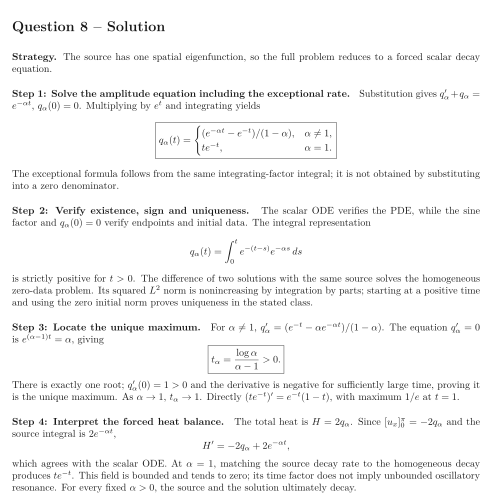
Question 8 – Solution
Strategy. The source has one spatial eigenfunction, so the full problem reduces to a forced scalar decay equation.
Step 1: Solve the amplitude equation including the exceptional rate. Substitution gives , . Multiplying by and integrating yields The exceptional formula follows from the same integrating-factor integral; it is not obtained by substituting into a zero denominator.
Step 2: Verify existence, sign and uniqueness. The scalar ODE verifies the PDE, while the sine factor and verify endpoints and initial data. The integral representation is strictly positive for . The difference of two solutions with the same source solves the homogeneous zero-data problem. Its squared norm is nonincreasing by integration by parts; starting at a positive time and using the zero initial norm proves uniqueness in the stated class.
Step 3: Locate the unique maximum. For , . The equation is , giving There is exactly one root; and the derivative is negative for sufficiently large time, proving it is the unique maximum. As , . Directly , with maximum at .
Step 4: Interpret the forced heat balance. The total heat is . Since and the source integral is , which agrees with the scalar ODE. At , matching the source decay rate to the homogeneous decay produces . This field is bounded and tends to zero; its time factor does not imply unbounded oscillatory resonance. For every fixed , the source and the solution ultimately decay.