Question 7
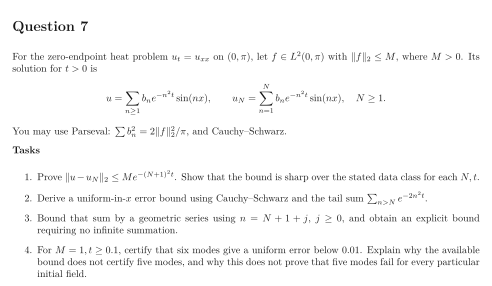
For the zero-endpoint heat problem on , let with , where . Its solution for is You may use Parseval: , and Cauchy–Schwarz.
Tasks
Prove . Show that the bound is sharp over the stated data class for each .
Derive a uniform-in- error bound using Cauchy–Schwarz and the tail sum .
Bound that sum by a geometric series using , , and obtain an explicit bound requiring no infinite summation.
For , certify that six modes give a uniform error below . Explain why the available bound does not certify five modes, and why this does not prove that five modes fail for every particular initial field.
Show solutionHide solution
Question 7 – Solution
Strategy. A truncation certificate needs a bound on the omitted coefficients, not just a graph of the retained modes.
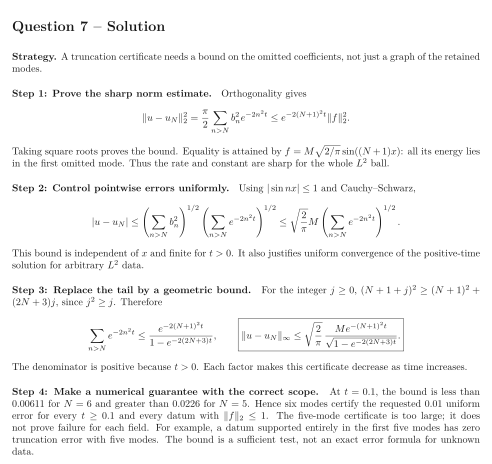
Step 1: Prove the sharp norm estimate. Orthogonality gives Taking square roots proves the bound. Equality is attained by : all its energy lies in the first omitted mode. Thus the rate and constant are sharp for the whole ball.
Step 2: Control pointwise errors uniformly. Using and Cauchy–Schwarz, This bound is independent of and finite for . It also justifies uniform convergence of the positive-time solution for arbitrary data.
Step 3: Replace the tail by a geometric bound. For the integer , , since . Therefore The denominator is positive because . Each factor makes this certificate decrease as time increases.
Step 4: Make a numerical guarantee with the correct scope. At , the bound is less than for and greater than for . Hence six modes certify the requested uniform error for every and every datum with . The five-mode certificate is too large; it does not prove failure for each field. For example, a datum supported entirely in the first five modes has zero truncation error with five modes. The bound is a sufficient test, not an exact error formula for unknown data.