Question 7
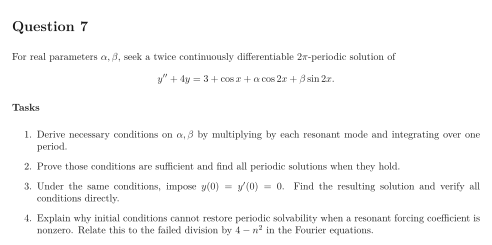
For real parameters , seek a twice continuously differentiable -periodic solution of
Tasks
Derive necessary conditions on by multiplying by each resonant mode and integrating over one period.
Prove those conditions are sufficient and find all periodic solutions when they hold.
Under the same conditions, impose . Find the resulting solution and verify all conditions directly.
Explain why initial conditions cannot restore periodic solvability when a resonant forcing coefficient is nonzero. Relate this to the failed division by in the Fourier equations.
Show solutionHide solution
Question 7 – Solution
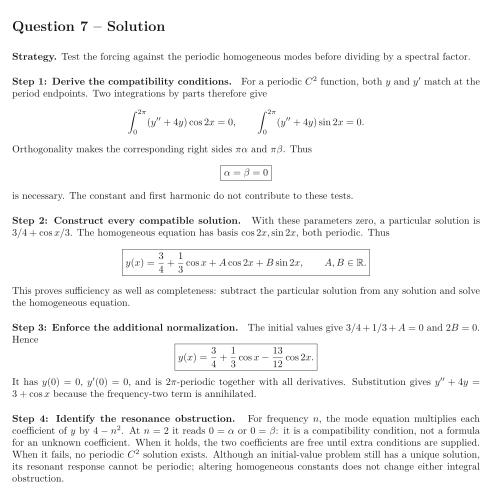
Strategy. Test the forcing against the periodic homogeneous modes before dividing by a spectral factor.
Step 1: Derive the compatibility conditions. For a periodic function, both and match at the period endpoints. Two integrations by parts therefore give Orthogonality makes the corresponding right sides and . Thus is necessary. The constant and first harmonic do not contribute to these tests.
Step 2: Construct every compatible solution. With these parameters zero, a particular solution is . The homogeneous equation has basis , both periodic. Thus This proves sufficiency as well as completeness: subtract the particular solution from any solution and solve the homogeneous equation.
Step 3: Enforce the additional normalization. The initial values give and . Hence It has , , and is -periodic together with all derivatives. Substitution gives because the frequency-two term is annihilated.
Step 4: Identify the resonance obstruction. For frequency , the mode equation multiplies each coefficient of by . At it reads or : it is a compatibility condition, not a formula for an unknown coefficient. When it holds, the two coefficients are free until extra conditions are supplied. When it fails, no periodic solution exists. Although an initial-value problem still has a unique solution, its resonant response cannot be periodic; altering homogeneous constants does not change either integral obstruction.