Question 3
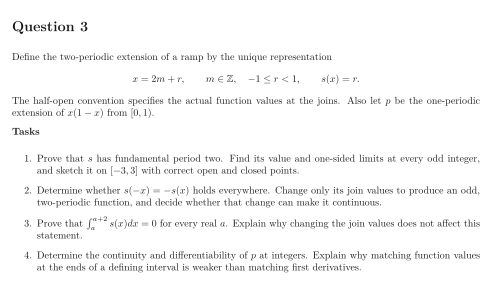
Define the two-periodic extension of a ramp by the unique representation The half-open convention specifies the actual function values at the joins. Also let be the one-periodic extension of from .
Tasks
Prove that has fundamental period two. Find its value and one-sided limits at every odd integer, and sketch it on with correct open and closed points.
Determine whether holds everywhere. Change only its join values to produce an odd, two-periodic function, and decide whether that change can make it continuous.
Prove that for every real . Explain why changing the join values does not affect this statement.
Determine the continuity and differentiability of at integers. Explain why matching function values at the ends of a defining interval is weaker than matching first derivatives.
Show solutionHide solution
Question 3 – Solution
Strategy. Separate periodicity, assigned endpoint values, one-sided limits and integral properties.
Step 1: Locate the joins and establish minimality. The representation gives . Its discontinuities occur precisely at odd integers. Any period must preserve this set, so a positive period is a positive even integer; two is therefore fundamental. At , Each increasing segment has its left endpoint included and its right endpoint excluded. The graph also includes the assigned value .
Step 2: Repair oddness, not continuity. Away from odd integers, . At an odd integer both and equal , so pointwise oddness fails. Assigning zero at every odd integer produces an odd function and preserves two-periodicity. No assigned join value can reconcile the unequal one-sided limits, so the jumps remain.
Step 3: Integrate over any full period. The integral on is . Reduce modulo two to . Splitting at one and shifting the remaining piece by two gives Changing finitely many join values in any bounded interval leaves these Riemann integrals unchanged. Integral cancellation does not require pointwise oddness.
Step 4: Check a continuous periodic join. For , both endpoint limits of are zero, matching the assigned value at each integer. Thus is continuous everywhere. The left derivative at an integer is , while the right derivative is , so it is not differentiable there. Value matching alone does not give derivative matching.
See the diagram in the original worksheet below.
