Question 2
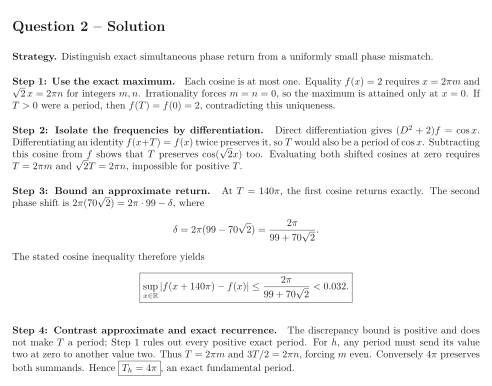
Consider a signal with incommensurate frequencies: A graph over a long interval may suggest repeated patterns without establishing an exact period. Recall that is irrational.
Tasks
Show that and determine every point where equality holds. Use this to prove that has no positive period.
For a second proof, apply to , where . Explain why a period of a smooth function is also a period of this derivative combination, and derive a contradiction.
Set . Prove a uniform bound on using and .
Decide whether this small uniform discrepancy makes an exact period. Contrast the result with , and determine the fundamental period of .
Show solutionHide solution
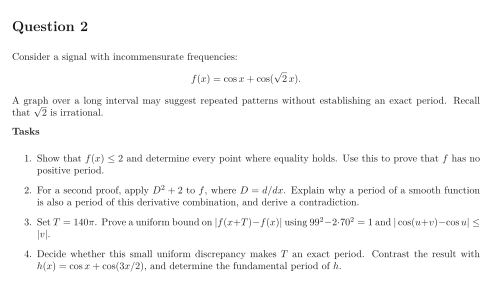
Question 2 – Solution
Strategy. Distinguish exact simultaneous phase return from a uniformly small phase mismatch.
Step 1: Use the exact maximum. Each cosine is at most one. Equality requires and for integers . Irrationality forces , so the maximum is attained only at . If were a period, then , contradicting this uniqueness.
Step 2: Isolate the frequencies by differentiation. Direct differentiation gives . Differentiating an identity twice preserves it, so would also be a period of . Subtracting this cosine from shows that preserves too. Evaluating both shifted cosines at zero requires and , impossible for positive .
Step 3: Bound an approximate return. At , the first cosine returns exactly. The second phase shift is , where The stated cosine inequality therefore yields
Step 4: Contrast approximate and exact recurrence. The discrepancy bound is positive and does not make a period; Step 1 rules out every positive exact period. For , any period must send its value two at zero to another value two. Thus and , forcing even. Conversely preserves both summands. Hence , an exact fundamental period.