Question 4
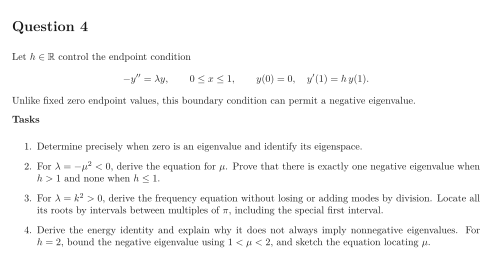
Let control the endpoint condition Unlike fixed zero endpoint values, this boundary condition can permit a negative eigenvalue.
Tasks
Determine precisely when zero is an eigenvalue and identify its eigenspace.
For , derive the equation for . Prove that there is exactly one negative eigenvalue when and none when .
For , derive the frequency equation without losing or adding modes by division. Locate all its roots by intervals between multiples of , including the special first interval.
Derive the energy identity and explain why it does not always imply nonnegative eigenvalues. For , bound the negative eigenvalue using , and sketch the equation locating .
Show solutionHide solution
Question 4 – Solution
Strategy. Separate all three signs and prove root counts by monotonicity on the correct domains.
Step 1: Check the zero parameter directly. At , and the right condition is . Thus zero is an eigenvalue exactly when , with eigenspace .
Step 2: Count the negative modes. For , the nonzero solution is a multiple of , and its endpoint condition is . The function tends to one as and to infinity as . Its derivative has numerator , since this numerator starts at zero and has derivative . Thus precisely gives one negative mode.
Step 3: Locate every positive mode. Here and . A positive multiple of cannot solve this equation, so division by is safe at a root: Its derivative is for away from poles. On each , , it decreases from to , giving exactly one root for every . On it decreases from the unattained limit one to : one root if , none if .
Step 4: Retain the endpoint energy term. Integration by parts gives , which can be negative. For , : the first inequality follows from and follows from . Thus and . The graph locates the unique crossing.
See the diagram in the original worksheet below.
