Question 3
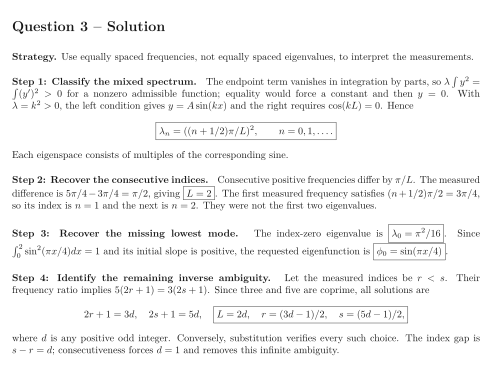
An unknown interval length has mixed boundary conditions: Two measurements are reported as consecutive eigenvalues, in increasing order: and . The report does not say they are the first two.
Tasks
Derive the complete real spectrum and rule out zero and negative values. Index the positive eigenvalues starting at .
Recover and the indices of the two measured modes. Explain why taking the difference of the square roots is useful.
Find the true lowest eigenvalue and normalize its eigenfunction by and .
Drop the claim that the measurements are consecutive. Characterize every possible length and pair of indices consistent with the same two numbers. Explain exactly what information the consecutiveness assumption supplied.
Show solutionHide solution
Question 3 – Solution
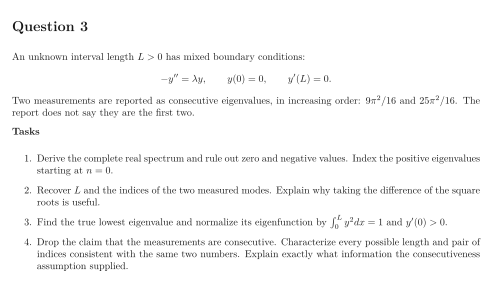
Strategy. Use equally spaced frequencies, not equally spaced eigenvalues, to interpret the measurements.
Step 1: Classify the mixed spectrum. The endpoint term vanishes in integration by parts, so for a nonzero admissible function; equality would force a constant and then . With , the left condition gives and the right requires . Hence Each eigenspace consists of multiples of the corresponding sine.
Step 2: Recover the consecutive indices. Consecutive positive frequencies differ by . The measured difference is , giving . The first measured frequency satisfies , so its index is and the next is . They were not the first two eigenvalues.
Step 3: Recover the missing lowest mode. The index-zero eigenvalue is . Since and its initial slope is positive, the requested eigenfunction is .
Step 4: Identify the remaining inverse ambiguity. Let the measured indices be . Their frequency ratio implies . Since three and five are coprime, all solutions are where is any positive odd integer. Conversely, substitution verifies every such choice. The index gap is ; consecutiveness forces and removes this infinite ambiguity.