Question 9
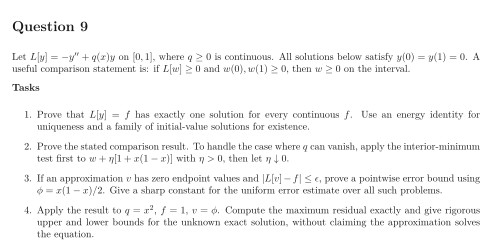
Let on , where is continuous. All solutions below satisfy . A useful comparison statement is: if and , then on the interval.
Tasks
Prove that has exactly one solution for every continuous . Use an energy identity for uniqueness and a family of initial-value solutions for existence.
Prove the stated comparison result. To handle the case where can vanish, apply the interior-minimum test first to with , then let .
If an approximation has zero endpoint values and , prove a pointwise error bound using . Give a sharp constant for the uniform error estimate over all such problems.
Apply the result to , , . Compute the maximum residual exactly and give rigorous upper and lower bounds for the unknown exact solution, without claiming the approximation solves the equation.
Show solutionHide solution
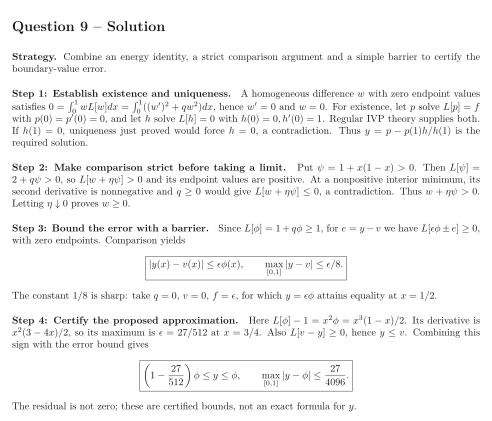
Question 9 – Solution
Strategy. Combine an energy identity, a strict comparison argument and a simple barrier to certify the boundary-value error.
Step 1: Establish existence and uniqueness. A homogeneous difference with zero endpoint values satisfies , hence and . For existence, let solve with , and let solve with . Regular IVP theory supplies both. If , uniqueness just proved would force , a contradiction. Thus is the required solution.
Step 2: Make comparison strict before taking a limit. Put . Then , so and its endpoint values are positive. At a nonpositive interior minimum, its second derivative is nonnegative and would give , a contradiction. Thus . Letting proves .
Step 3: Bound the error with a barrier. Since , for we have , with zero endpoints. Comparison yields The constant is sharp: take , , , for which attains equality at .
Step 4: Certify the proposed approximation. Here . Its derivative is , so its maximum is at . Also , hence . Combining this sign with the error bound gives The residual is not zero; these are certified bounds, not an exact formula for .