Question 8
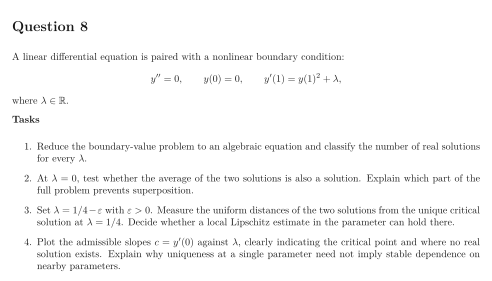
A linear differential equation is paired with a nonlinear boundary condition: where .
Tasks
Reduce the boundary-value problem to an algebraic equation and classify the number of real solutions for every .
At , test whether the average of the two solutions is also a solution. Explain which part of the full problem prevents superposition.
Set with . Measure the uniform distances of the two solutions from the unique critical solution at . Decide whether a local Lipschitz estimate in the parameter can hold there.
Plot the admissible slopes against , clearly indicating the critical point and where no real solution exists. Explain why uniqueness at a single parameter need not imply stable dependence on nearby parameters.
Show solutionHide solution
Question 8 – Solution
Strategy. Solve the differential equation completely, then retain the nonlinear structure of its endpoint constraint.
Step 1: Classify the slope equation. Every solution of is . Its remaining boundary condition is , so There are two real solutions for , one for , and none for . The critical solution is .
Step 2: Check the superposition claim. At , the solutions are and . Their average has but , so it fails the boundary condition. The differential equation is linear, but the square in the boundary operator makes the full boundary-value problem nonlinear.
Step 3: Quantify critical sensitivity. At , the slopes are . Hence A Lipschitz bound with fixed constant would require for all sufficiently small positive , which is impossible. Both branches approach continuously from this side, but not at a rate bounded linearly by the parameter error.
Step 4: Read the complete branch picture. The branches meet at and have no real continuation for larger . For , , whose magnitude diverges at the join. Critical uniqueness therefore does not guarantee a locally unique family or a Lipschitz-stable response.
See the diagram in the original worksheet below.
