Question 7
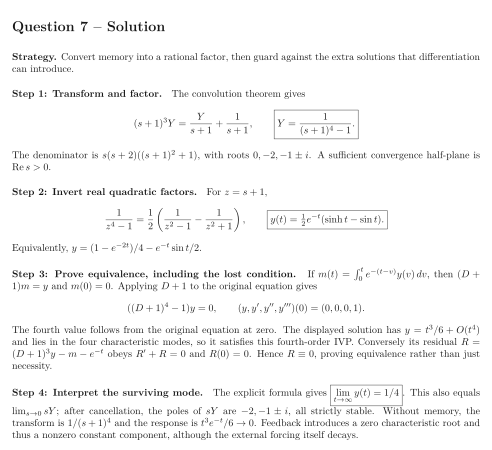
A third-order equation has an exponentially fading memory: All functions are defined for .
Tasks
Transform the convolution equation and solve algebraically for . Factor the resulting fourth-degree denominator.
Invert the transform in a real form, displaying a useful decomposition in .
Derive an equivalent ordinary fourth-order initial-value problem. Explain why differentiation requires an additional initial condition, and prove that your fourth-order solution really satisfies the original memory equation.
Determine the long-time limit and justify any final-value theorem used. Explain how the feedback changes the zero-state response from what it would be if the memory integral were omitted.
Show solutionHide solution
Question 7 – Solution
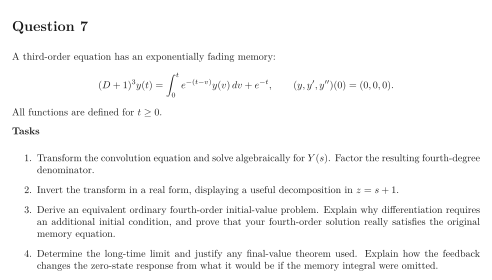
Strategy. Convert memory into a rational factor, then guard against the extra solutions that differentiation can introduce.
Step 1: Transform and factor. The convolution theorem gives The denominator is , with roots . A sufficient convergence half-plane is .
Step 2: Invert real quadratic factors. For , Equivalently, .
Step 3: Prove equivalence, including the lost condition. If , then and . Applying to the original equation gives The fourth value follows from the original equation at zero. The displayed solution has and lies in the four characteristic modes, so it satisfies this fourth-order IVP. Conversely its residual obeys and . Hence , proving equivalence rather than just necessity.
Step 4: Interpret the surviving mode. The explicit formula gives . This also equals ; after cancellation, the poles of are , all strictly stable. Without memory, the transform is and the response is . Feedback introduces a zero characteristic root and thus a nonzero constant component, although the external forcing itself decays.