Question 6
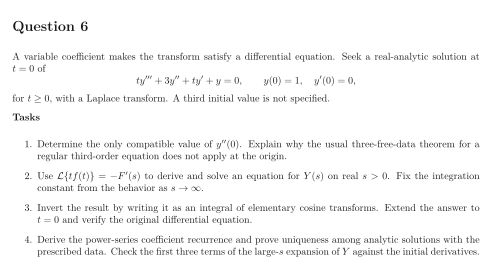
A variable coefficient makes the transform satisfy a differential equation. Seek a real-analytic solution at of for , with a Laplace transform. A third initial value is not specified.
Tasks
Determine the only compatible value of . Explain why the usual three-free-data theorem for a regular third-order equation does not apply at the origin.
Use to derive and solve an equation for on real . Fix the integration constant from the behavior as .
Invert the result by writing it as an integral of elementary cosine transforms. Extend the answer to and verify the original differential equation.
Derive the power-series coefficient recurrence and prove uniqueness among analytic solutions with the prescribed data. Check the first three terms of the large- expansion of against the initial derivatives.
Show solutionHide solution
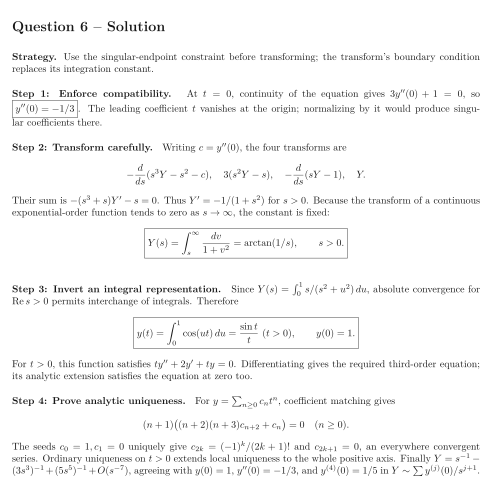
Question 6 – Solution
Strategy. Use the singular-endpoint constraint before transforming; the transform’s boundary condition replaces its integration constant.
Step 1: Enforce compatibility. At , continuity of the equation gives , so . The leading coefficient vanishes at the origin; normalizing by it would produce singular coefficients there.
Step 2: Transform carefully. Writing , the four transforms are Their sum is . Thus for . Because the transform of a continuous exponential-order function tends to zero as , the constant is fixed:
Step 3: Invert an integral representation. Since , absolute convergence for permits interchange of integrals. Therefore For , this function satisfies . Differentiating gives the required third-order equation; its analytic extension satisfies the equation at zero too.
Step 4: Prove analytic uniqueness. For , coefficient matching gives The seeds uniquely give and , an everywhere convergent series. Ordinary uniqueness on extends local uniqueness to the whole positive axis. Finally , agreeing with , , and in .