Question 5
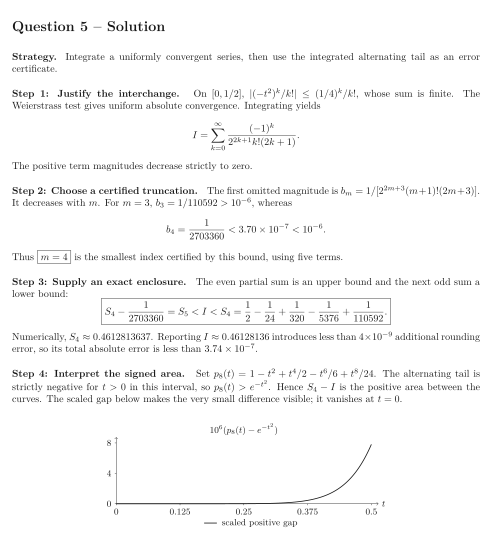
Consider the nonelementary integral An accuracy certificate is required; a decimal from a calculator is insufficient.
Tasks
Derive the series for and justify integrating the Maclaurin series term by term on the whole integration interval.
Find the smallest for which the first-omitted-term bound certifies , and state the number of terms used.
Give an exact rational enclosure for using that partial sum and the next one. Report an approximation with its certified absolute error.
Explain the sign of the error geometrically by comparing with the degree- polynomial under the integral on .
Show solutionHide solution
Question 5 – Solution
Strategy. Integrate a uniformly convergent series, then use the integrated alternating tail as an error certificate.
Step 1: Justify the interchange. On , , whose sum is finite. The Weierstrass test gives uniform absolute convergence. Integrating yields The positive term magnitudes decrease strictly to zero.
Step 2: Choose a certified truncation. The first omitted magnitude is . It decreases with . For , , whereas Thus is the smallest index certified by this bound, using five terms.
Step 3: Supply an exact enclosure. The even partial sum is an upper bound and the next odd sum a lower bound: Numerically, . Reporting introduces less than additional rounding error, so its total absolute error is less than .
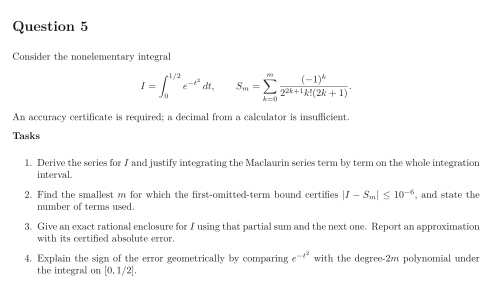
Step 4: Interpret the signed area. Set . The alternating tail is strictly negative for in this interval, so . Hence is the positive area between the curves. The scaled gap below makes the very small difference visible; it vanishes at .
See the diagram in the original worksheet below.